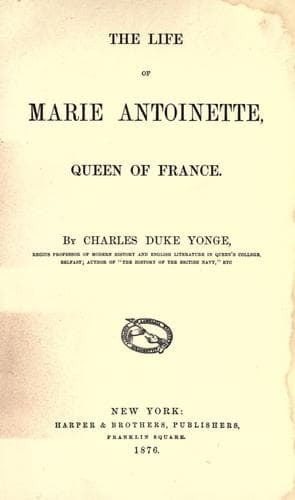
The Life of Marie Antoinette, Queen of FranceYonge, Charles Duke
History
The Life of Marie Antoinette, Queen of France
Yonge, Charles Duke
Marie Antoinette, Queen, consort of Louis XVI, King of France, 1755-1793
sovereign, the Parisian populace took their part; and some of them who
showed themselves ostentatiously in the streets of the city on days on
which there were parties at Versailles were loudly applauded by a crowd
which was not entirely drawn from the lower classes. It was noticed that
the Duc de Chartres, the son of the Duc d'Orléans, was one of the foremost
in exciting this anti-Austrian feeling, the outbreak of which was
especially remarkable as the first instance in which the enthusiasm of the
citizens for Marie Antoinette seemed to have cooled, or at least to have
been interrupted. And this change in their feelings produced so painful an
impression on her mind, that, after her brother's departure, she abandoned
her intention of going to the opera, though Gluck's "Orfeo" was to be
performed, lest she should meet with a reception less cordial than that to
which she had hitherto been accustomed.
This ebullition against the house of Austria, however, was at the moment
dictated rather by discontent with the Home Government than by any settled
feeling on the subject of foreign politics. Corn had been at a rather high
price in Paris and its neighborhood throughout the winter; and the
dearness was taken advantage of by the enemies of Turgot, and employed by
them as an argument to prove the impolicy of his measures to introduce
freedom of trade. They even organized[3] formidable riots at Paris and
Versailles, which, however, Turgot, whose resolution was equal to his
capacity, prevailed on the king to repress by acts of vigor very unusual
to him, and very foreign to his disposition. The troops were called out;
the Parliament was summoned to a Bed of Justice, and enjoined to put the
law in force against the guilty; two of the most violent revolters were
executed; order was restored, and the wholly factitious character of the
outbreak was proved by the tranquillity which ensued, though the price of
bread remained unaltered till the commencement of the harvest, the
citizens themselves presently making a jest of their sedition, and
nicknaming it The War of the Grains.[4]
Public-domain text, read in full here on John Shaqi.
Reviews
Reviews
No reviews yet
Be the first to share your thoughts on this work.
Elsewhere in the archive
Join the Discussion
Join the discussion
Sign in to leave a comment or review.
Sign InorCreate an account