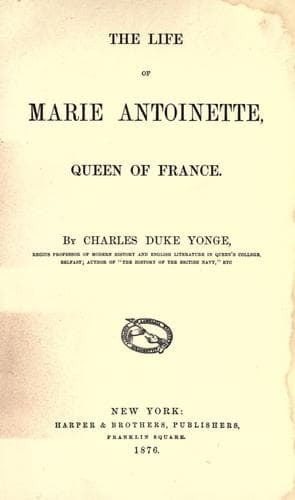
The Life of Marie Antoinette, Queen of FranceYonge, Charles Duke
History
The Life of Marie Antoinette, Queen of France
Yonge, Charles Duke
Marie Antoinette, Queen, consort of Louis XVI, King of France, 1755-1793
establishment; and would not fear to shock her aunts by tempting one of
her sisters-in-law to a game at ball, or battledoor and shuttlecock. But
she probably enjoyed still more the power of gratifying the inhabitants of
Versailles and the neighborhood. The moment that her improvements were
completed, she opened the gardens to the public to walk in, and gave
out-of-door parties and children's dances, to which all the inhabitants of
Versailles who presented themselves in decent apparel were admitted. She
would even open the dance herself with some well-conducted boy, and
afterward stroll among the crowd, talking affably to all the company, even
to the governesses and nurses, and delighting the parents with the
interest which she exhibited in the characters, the growth, and even the
names of the children.
There were some who, startled at the unwonted sight of a sovereign so
treating her subjects as fellow-creatures, confessed a fear that such
familiarity was not without its dangers;[6] but the objects of her
condescension worshiped her for it; and for a time at least the great
majority of the nation forgot that she was Austrian. She was now nearly
twenty years of age. Her form had developed into a rare perfection of
elegance. Her features had added to the original brilliancy of her girlish
loveliness something of that higher beauty which judgment and sagacity
inspire, and which dignity renders only the more imposing; while the same
benevolence and purity beamed in every look which were remarked as her
most sterling characteristics on her first arrival in the country. And it
is not to her French or German admirers alone that we are reduced to trust
for the impression which at this time she made on all beholders. We have
seen that English gentlemen and ladies of rank were frequent visitors to
the French court; and from two of these, men of widely different
characters, talents, and turns of mind, we have a striking concurrence of
testimony as to the power of the fascination which she exerted on all who
came within the sphere of her influence. Burke was the earlier visitor.
Indeed, it was in the last months of the preceding reign, while she was
still dauphiness, that she had excited in his enthusiastic imagination
those emotions which he afterward described in words which will live as
long as the English language. It was in the spring of 1774 that it seemed
to him that "surely never lighted on this orb, which she hardly seemed to
touch, a more delightful vision. I saw her just above the horizon,
decorating and cheering the elevated sphere she just began to move in--
glittering like the morning-star, full of life, and splendor, and joy." No
one could be less like Burke than Horace Walpole, a cynical observer, who
piqued himself on indifference, and especially on a superiority to the
vulgar belief in the merits and attractions of kings and princes. Yet his
report of the charms of Marie Antoinette, as he saw them in the autumn of
Public-domain text, read in full here on John Shaqi.
Reviews
Reviews
No reviews yet
Be the first to share your thoughts on this work.
Elsewhere in the archive
Join the Discussion
Join the discussion
Sign in to leave a comment or review.
Sign InorCreate an account