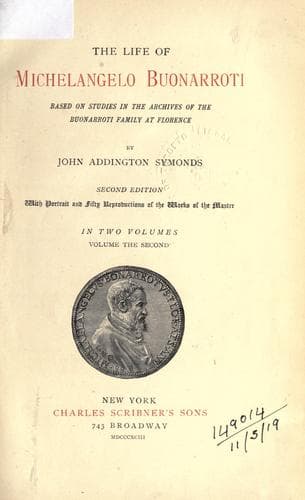
The Life of Michelangelo BuonarrotiSymonds, John Addington
History
The Life of Michelangelo Buonarroti
Symonds, John Addington
Michelangelo Buonarroti, 1475-1564
Considerable animation is introduced into the annals of Michelangelo's
life at this point by his correspondence with jovial Sebastiano del
Piombo. We possess one of this painter's letters, dating as early as
1510, when he thanks Buonarroti for consenting to be godfather to his
boy Luciano; a second of 1512, which contains the interesting account
of his conversation with Pope Julius about Michelangelo and Raffaello;
and a third, of 1518, turning upon the rivalry between the two great
artists. But the bulk of Sebastiano's gossipy and racy communications
belongs to the period of thirteen years between 1520 and 1533; then it
suddenly breaks off, owing to Michelangelo's having taken up his
residence at Rome during the autumn of 1533. A definite rupture at
some subsequent period separated the old friends. These letters are a
mine of curious information respecting artistic life at Rome. They
prove, beyond the possibility of doubt, that, whatever Buonarroti and
Sanzio may have felt, their flatterers, dependants, and creatures
cherished the liveliest hostility and lived in continual rivalry. It
is somewhat painful to think that Michelangelo could have lent a
willing ear to the malignant babble of a man so much inferior to
himself in nobleness of nature--have listened when Sebastiano taunted
Raffaello as "Prince of the Synagogue," or boasted that a picture of
his own was superior to "the tapestries just come from Flanders." Yet
Sebastiano was not the only friend to whose idle gossip the great
sculptor indulgently stooped. Lionardo, the saddle-maker, was even
more offensive. He writes, for instance, upon New Year's Day, 1519, to
say that the Resurrection of Lazarus, for which Michelangelo had
contributed some portion of the design, was nearly finished, and adds:
"Those who understand art rank it far above Raffaello. The vault, too,
of Agostino Chigi has been exposed to view, and is a thing truly
disgraceful to a great artist, far worse than the last hall of the
Palace. Sebastiano has nothing to fear."
We gladly turn from these quarrels to what Sebastiano teaches us about
Michelangelo's personal character. The general impression in the world
was that he was very difficult to live with. Julius, for instance,
after remarking that Raffaello changed his style in imitation of
Buonarroti, continued: "'But he is terrible, as you see; one cannot
get on with him.' I answered to his Holiness that your terribleness
hurt nobody, and that you only seem to be terrible because of your
passionate devotion to the great works you have on hand." Again, he
relates Leo's estimate of his friend's character:
Public-domain text, read in full here on John Shaqi.
Reviews
Reviews
No reviews yet
Be the first to share your thoughts on this work.
Elsewhere in the archive
Join the Discussion
Join the discussion
Sign in to leave a comment or review.
Sign InorCreate an account