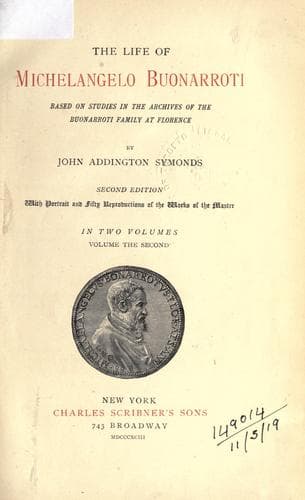
The Life of Michelangelo BuonarrotiSymonds, John Addington
History
The Life of Michelangelo Buonarroti
Symonds, John Addington
Michelangelo Buonarroti, 1475-1564
The Christ became very famous. Francis I. had it cast and sent to
Paris, to be repeated in bronze. What is more strange, it has long
been the object of a religious cult. The right foot, so mangled by
poor Pietro, wears a fine brass shoe, in order to prevent its being
kissed away. This almost makes one think of Goethe's hexameter:
"Wunderthätige Bilder sind meist nur schlechte Gemälde." Still it must
be remembered that excellent critics have found the whole work
admirable. Gsell-Fels says: "It is his second Moses; in movement and
physique one of the greatest masterpieces; as a Christ-ideal, the
heroic conception of a humanist." That last observation is just. We
may remember that Vida was composing his _Christiad_ while Frizzi was
curling the beard of the Cristo Risorto. Vida always speaks of Jesus
as _Heros_ and of God the Father as _Superum Pater Nimbipotens_ or
_Regnator Olympi_.
CHAPTER VIII
I
Leo X. expired upon the 1st day of December 1521. The vacillating game
he played in European politics had just been crowned with momentary
success. Some folk believed that the Pope died of joy after hearing
that his Imperial allies had entered the town of Milan; others thought
that he succumbed to poison. We do not know what caused his death. But
the unsoundness of his constitution, over-taxed by dissipation and
generous living, in the midst of public cares for which the man had
hardly nerve enough, may suffice to account for a decease certainly
sudden and premature. Michelangelo, born in the same year, was
destined to survive him through more than eight lustres of the life of
man.
Leo was a personality whom it is impossible to praise without reserve.
The Pope at that time in Italy had to perform three separate
functions. His first duty was to the Church. Leo left the See of Rome
worse off than he found it: financially bankrupt, compromised by vague
schemes set on foot for the aggrandisement of his family, discredited
by many shameless means for raising money upon spiritual securities.
His second duty was to Italy. Leo left the peninsula so involved in a
mesh of meaningless entanglements, diplomatic and aimless wars, that
anarchy and violence proved to be the only exit from the situation.
His third duty was to that higher culture which Italy dispensed to
Europe, and of which the Papacy had made itself the leading
propagator. Here Leo failed almost as conspicuously as in all else he
attempted. He debased the standard of art and literature by his
ill-placed liberalities, seeking quick returns for careless
expenditure, not selecting the finest spirits of his age for timely
patronage, diffusing no lofty enthusiasm, but breeding round him
mushrooms of mediocrity.
Public-domain text, read in full here on John Shaqi.
Reviews
Reviews
No reviews yet
Be the first to share your thoughts on this work.
Elsewhere in the archive
Join the Discussion
Join the discussion
Sign in to leave a comment or review.
Sign InorCreate an account