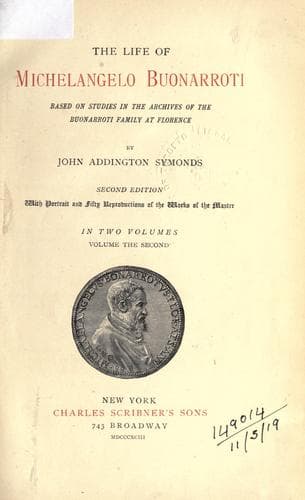
The Life of Michelangelo BuonarrotiSymonds, John Addington
History
The Life of Michelangelo Buonarroti
Symonds, John Addington
Michelangelo Buonarroti, 1475-1564
After his death, upon the 23rd of September 1523, the Cardinal Giulio
de' Medici was made Pope. He assumed the title of Clement VII. upon
the 9th of November. The wits who saluted Adrian's doctor with the
title of "Saviour of the Fatherland," now rejoiced at the election of
an Italian and a Medici. The golden years of Leo's reign would
certainly return, they thought; having no foreknowledge of the tragedy
which was so soon to be enacted, first at Rome, and afterwards at
Florence, Michelangelo wrote to his friend Topolino at Carrara: "You
will have heard that Medici is made Pope; all the world seems to me to
be delighted, and I think that here at Florence great things will soon
be set on foot in our art. Therefore, serve well and faithfully."
II
Our records are very scanty, both as regards personal details and
art-work, for the life of Michelangelo during the pontificate of
Adrian VI. The high esteem in which he was held throughout Italy is
proved by three incidents which may shortly be related. In 1522, the
Board of Works for the cathedral church of S. Petronio at Bologna
decided to complete the façade. Various architects sent in designs;
among them Peruzzi competed with one in the Gothic style, and another
in that of the Classical revival. Great differences of opinion arose
in the city as to the merits of the rival plans, and the Board in July
invited Michelangelo, through their secretary, to come and act as
umpire. They promised to reward him magnificently. It does not appear
that Michelangelo accepted the offer. In 1523, Cardinal Grimani, who
was a famous collector of art-objects, wrote begging for some specimen
of his craft. Grimani left it open to him "to choose material and
subject; painting, bronze, or marble, according to his fancy."
Michelangelo must have promised to fulfill the commission, for we have
a letter from Grimani thanking him effusively. He offers to pay fifty
ducats at the commencement of the work, and what Michelangelo thinks
fit to demand at its conclusion: "for such is the excellence of your
ability, that we shall take no thought of money-value." Grimani was
Patriarch of Aquileja. In the same year, 1523, the Genoese entered
into negotiations for a colossal statue of Andrea Doria, which they
desired to obtain from the hand of Michelangelo. Its execution must
have been seriously contemplated, for the Senate of Genoa banked 300
ducats for the purpose. We regret that Michelangelo could not carry
out a work so congenial to his talent as this ideal portrait of the
mighty Signer Capitano would have been; but we may console ourselves
by reflecting that even his energies were not equal to all tasks
imposed upon him. The real matter for lamentation is that they
suffered so much waste in the service of vacillating Popes.
Public-domain text, read in full here on John Shaqi.
Reviews
Reviews
No reviews yet
Be the first to share your thoughts on this work.
Elsewhere in the archive
Join the Discussion
Join the discussion
Sign in to leave a comment or review.
Sign InorCreate an account