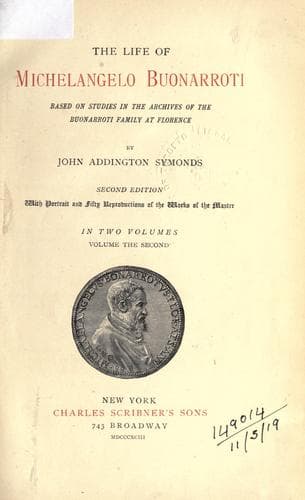
The Life of Michelangelo BuonarrotiSymonds, John Addington
History
The Life of Michelangelo Buonarroti
Symonds, John Addington
Michelangelo Buonarroti, 1475-1564
Michelangelo began the library in 1526, as appears from his _Ricordi._
Still the work went on slowly, not through his negligence, but, as we
have seen, from the Pope's preoccupation with graver matters. He had a
great many workmen in his service at this period, and employed
celebrated masters in their crafts, as Tasso and Carota for
wood-carving, Battista del Cinque and Ciapino for carpentry, upon the
various fittings of the library. All these details he is said to have
designed; and it is certain that he was considered responsible for
their solidity and handsome appearance. Sebastiano, for instance,
wrote to him about the benches: "Our Lord wishes that the whole work
should be of carved walnut. He does not mind spending three florins
more; for that is a trifle, if they are Cosimesque in style, I mean
resemble the work done for the magnificent Cosimo." Michelangelo could
not have been the solitary worker of legend and tradition. The nature
of his present occupations rendered this impossible. For the
completion of his architectural works he needed a band of able
coadjutors. Thus in 1526 Giovanni da Udine came from Rome to decorate
the vault of the sacristy with frescoed arabesques. His work was
nearly terminated in 1533, when some question arose about painting the
inside of the lantern. Sebastiano, apparently in good faith, made the
following burlesque suggestion: "For myself, I think that the Ganymede
would go there very well; one could put an aureole about him, and turn
him into a S. John of the Apocalypse when he is being caught up into
the heavens." The whole of one side of the Italian Renaissance, its
so-called neo-paganism, is contained in this remark.
While still occupied with thoughts about S. Lorenzo, Clement ordered
Michelangelo to make a receptacle for the precious vessels and
reliques collected by Lorenzo the Magnificent. It was first intended
to place this chest, in the form of a ciborium, above the high altar,
and to sustain it on four columns. Eventually, the Pope resolved that
it should be a sacrarium, or cabinet for holy things, and that this
should stand above the middle entrance door to the church. The chest
was finished, and its contents remained there until the reign of the
Grand Duke Pietro Leopoldo, when they were removed to the chapel next
the old sacristy.
Another very singular idea occurred to his Holiness in the autumn of
1525. He made Fattucci write that he wished to erect a colossal statue
on the piazza of S. Lorenzo, opposite the Stufa Palace. The giant was
to surmount the roof of the Medicean Palace, with its face turned in
that direction and its back to the house of Luigi della Stufa. Being
so huge, it would have to be composed of separate pieces fitted
together. Michelangelo speedily knocked this absurd plan on the head
in a letter which gives a good conception of his dry and somewhat
ponderous humour.
Public-domain text, read in full here on John Shaqi.
Reviews
Reviews
No reviews yet
Be the first to share your thoughts on this work.
Elsewhere in the archive
Join the Discussion
Join the discussion
Sign in to leave a comment or review.
Sign InorCreate an account