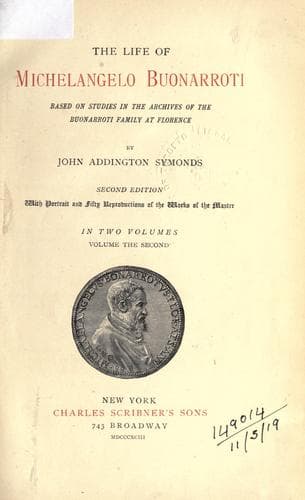
The Life of Michelangelo BuonarrotiSymonds, John Addington
History
The Life of Michelangelo Buonarroti
Symonds, John Addington
Michelangelo Buonarroti, 1475-1564
It lies outside the scope of this work to describe the series of
events which led up to the sack of Rome in 1527. Clement, by his
tortuous policy, and by the avarice of his administration, had
alienated every friend and exasperated all his foes. The Eternal City
was in a state of chronic discontent and anarchy. The Colonna princes
drove the Pope to take refuge in the Castle of S. Angelo; and when the
Lutheran rabble raised by Frundsberg poured into Lombardy, the Duke of
Ferrara assisted them to cross the Po, and the Duke of Urbino made no
effort to bar the passes of the Apennines. Losing one leader after the
other, these ruffians, calling themselves an Imperial army, but being
in reality the scum and offscourings of all nations, without any aim
but plunder and ignorant of policy, reached Rome upon the 6th of May.
They took the city by assault, and for nine months Clement, leaning
from the battlements of Hadrian's Mausoleum, watched smoke ascend from
desolated palaces and desecrated temples, heard the wailing of women
and the groans of tortured men, mingling with the ribald jests of
German drunkards and the curses of Castilian bandits. Roaming those
galleries and gazing from those windows, he is said to have exclaimed
in the words of Job: "Why died I not from the womb? why did I not give
up the ghost when I came out of the belly?"
The immediate effect of this disaster was that the Medici lost their
hold on Florence. The Cardinal of Cortona, with the young princes
Ippolito and Alessandro de' Medici, fled from the city on the 17th of
May, and a popular government was set up under the presidency of
Niccolò Capponi.
During this year and the next, Michelangelo was at Florence; but we
know very little respecting the incidents of his life. A _Ricordo_
bearing the date April 29 shows the disturbed state of the town. "I
record how, some days ago, Piero di Filippo Gondi asked for permission
to enter the new sacristy at S. Lorenzo, in order to hide there
certain goods belonging to his family, by reason of the perils in
which we are now. To-day, upon the 29th of April 1527, he has begun to
carry in some bundles, which he says are linen of his sisters; and I,
not wishing to witness what he does or to know where he hides the gear
away, have given him the key of the sacristy this evening."
There are only two letters belonging to the year 1527. Both refer to a
small office which had been awarded to Michelangelo with the right to
dispose of the patronage. He offered it to his favourite brother,
Buonarroto, who does not seem to have thought it worth accepting.
Public-domain text, read in full here on John Shaqi.
Reviews
Reviews
No reviews yet
Be the first to share your thoughts on this work.
Elsewhere in the archive
Join the Discussion
Join the discussion
Sign in to leave a comment or review.
Sign InorCreate an account