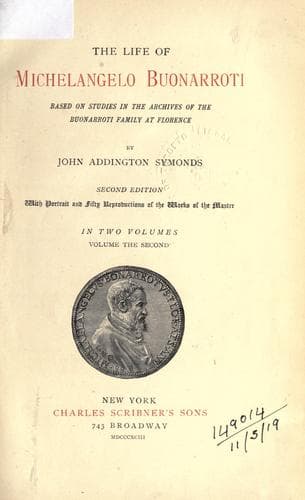
The Life of Michelangelo BuonarrotiSymonds, John Addington
History
The Life of Michelangelo Buonarroti
Symonds, John Addington
Michelangelo Buonarroti, 1475-1564
At the end of the year 1528 it became clear to the Florentines that
they would have to reckon with Clement VII. As early as August 18,
1527, France and England leagued together, and brought pressure upon
Charles V., in whose name Rome had been sacked. Negotiations were
proceeding, which eventually ended in the peace of Barcelona (June 20,
1529), whereby the Emperor engaged to sacrifice the Republic to the
Pope's vengeance. It was expected that the remnant of the Prince of
Orange's army would be marched up to besiege the town. Under the
anxiety caused by these events, the citizens raised a strong body of
militia, enlisted Malatesta Baglioni and Stefano Colonna as generals,
and began to take measures for strengthening the defences. What may be
called the War Office of the Florentine Republic bore the title of
Dieci della Guerra, or the Ten. It was their duty to watch over and
provide for all the interests of the commonwealth in military matters,
and now at this juncture serious measures had to be taken for putting
the city in a state of defence. Already in the year 1527, after the
expulsion of the Medici, a subordinate board had been created, to whom
very considerable executive and administrative faculties were
delegated. This board, called the Nove della Milizia, or the Nine,
were empowered to enrol all the burghers under arms, and to take
charge of the walls, towers, bastions, and other fortifications. It
was also within their competence to cause the destruction of
buildings, and to compensate the evicted proprietors at a valuation
which they fixed themselves. In the spring of 1529 the War Office
decided to gain the services of Michelangelo, not only because he was
the most eminent architect of his age in Florence, but also because
the Buonarroti family had always been adherents of the Medicean party,
and the Ten judged that his appointment to a place on the Nove di
Milizia would be popular with the democracy. The patent conferring
this office upon him, together with full authority over the work of
fortification, was issued on the 6th of April. Its terms were highly
complimentary. "Considering the genius and practical attainments of
Michelangelo di Lodovico Buonarroti, our citizen, and knowing how
excellent he is in architecture, beside his other most singular
talents in the liberal arts, by virtue whereof the common consent of
men regards him as unsurpassed by any masters of our times; and,
moreover, being assured that in love and affection toward the country
he is the equal of any other good and loyal burgher; bearing in mind,
too, the labour he has undergone and the diligence he has displayed,
gratis and of his free will, in the said work (of fortification) up to
this day; and wishing to employ his industry and energies to the like
effect in future; we, of our motion and initiative, do appoint him to
be governor and procurator-general over the construction and
fortification of the city walls, as well as every other sort of
Public-domain text, read in full here on John Shaqi.
Reviews
Reviews
No reviews yet
Be the first to share your thoughts on this work.
Elsewhere in the archive
Join the Discussion
Join the discussion
Sign in to leave a comment or review.
Sign InorCreate an account