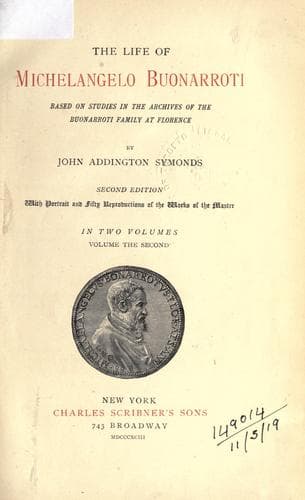
The Life of Michelangelo BuonarrotiSymonds, John Addington
History
The Life of Michelangelo Buonarroti
Symonds, John Addington
Michelangelo Buonarroti, 1475-1564
As usual with Condivi, this paragraph gives a general and yet
substantially accurate account of what really took place. The decisive
document, however, which throws light upon Michelangelo's mind in the
transaction, is a letter written by him from Venice to his friend
Battista della Palla on the 25th of September. Palla, who was an agent
for Francis I. in works of Italian art, antiques, and bric-a-brac, had
long purposed a journey into France; and Michelangelo, considering the
miserable state of Italian politics, agreed to join him. These
explanations will suffice to make the import of Michelangelo's letter
clear.
"Battista, dearest friend, I left Florence, as I think you know,
meaning to go to France. When I reached Venice, I inquired about the
road, and they told me I should have to pass through German territory,
and that the journey is both perilous and difficult. Therefore I
thought it well to ask you, at your pleasure, whether you are still
inclined to go, and to beg you; and so I entreat you, let me know, and
say where you want me to wait for you, and we will travel together, I
left home without speaking to any of my friends, and in great
confusion. You know that I wanted in any case to go to France, and
often asked for leave, but did not get it. Nevertheless I was quite
resolved, and without any sort of fear, to see the end of the war out
first. But on Tuesday morning, September 21, a certain person came out
by the gate at S. Niccolò, where I was attending to the bastions, and
whispered in my ear that, if I meant to save my life, I must not stay
at Florence. He accompanied me home, dined there, brought me horses,
and never left my side till he got me outside the city, declaring that
this was my salvation. Whether God or the devil was the man, I do not
know.
"Pray answer the questions in this letter as soon as possible, because
I am burning with impatience to set out. If you have changed your
mind, and do not care to go, still let me know, so that I may provide
as best I can for my own journey."
What appears manifest from this document is that Michelangelo was
decoyed away from Florence by some one, who, acting on his sensitive
nervous temperament, persuaded him that his life was in danger. Who
the man was we do not know, but he must have been a person delegated
by those who had a direct interest in removing Buonarroti from the
place. If the controller-general of the defences already scented
treason in the air, and was communicating his suspicions to the
Signory, Malatesta Baglioni, the archtraitor, who afterwards delivered
Florence over for a price to Clement, could not but have wished to
frighten him away.
From another of Michelangelo's letters we learn that he carried 3000
ducats in specie with him on the journey. It is unlikely that he could
have disposed so much cash upon his person. He must have had
companions.
Public-domain text, read in full here on John Shaqi.
Reviews
Reviews
No reviews yet
Be the first to share your thoughts on this work.
Elsewhere in the archive
Join the Discussion
Join the discussion
Sign in to leave a comment or review.
Sign InorCreate an account