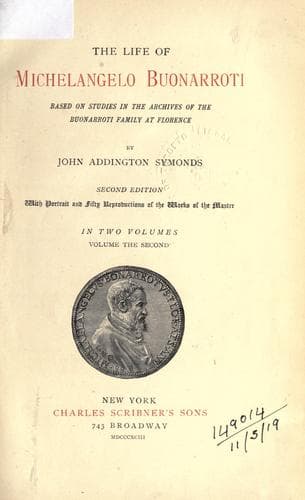
The Life of Michelangelo BuonarrotiSymonds, John Addington
History
The Life of Michelangelo Buonarroti
Symonds, John Addington
Michelangelo Buonarroti, 1475-1564
"Honoured Sir. In Venice, this tenth day of September.... Ten ducats
to Rinaldo Corsini. Five ducats to Messer Loredan for the rent of the
house. Seventeen lire for the stockings of Antonio (Mini, perhaps).
For two stools, a table to eat on, and a coffer, half a ducat. Eight
soldi for straw. Forty soldi for the hire of the bed. Ten lire to the
man (_fante_) who came from Florence. Three ducats to Bondino for the
journey to Venice with boats. Twenty soldi to Piloto for a pair of
shoes. Fourteen days' board in Venice, twenty lire."
It has been argued from the date of the unfinished letter below which
these items are jotted down, that Michelangelo must have been in
Venice early in September, before his flight from Florence at the end
of that month. But whatever weight we may attach to this single date,
there is no corroborative proof that he travelled twice to Venice, and
everything in the _Ricordo_ indicates that it refers to the period of
his flight from Florence. The sum paid to Corsini comes first, because
it must have been disbursed when that man broke the journey at
Ferrara. Antonio Mini and Piloto are both mentioned: a house has been
engaged, and furnished with Michelangelo's usual frugality, as though
he contemplated a residence of some duration. All this confirms
Busini, Varchi, Segni, Nardi, and Vasari in the general outlines of
their reports. I am of opinion that, unassisted by further evidence,
the _Ricordo_, in spite of its date, will not bear out Gotti's view
that Michelangelo sought Venice on a privy mission at the end of
August 1529. He was not likely to have been employed as ambassador
extraordinary; the Signory required his services at home; and after
Ferrara, Venice had little of importance to show the
controller-general of defences in the way of earthworks and bastions.
IV
Varchi says that Michelangelo, when he reached Venice, "wishing to
avoid visits and ceremonies, of which he was the greatest enemy, and
in order to live alone, according to his custom, far away from
company, retired quietly to the Giudecca; but the Signory, unable to
ignore the advent of so eminent a man, sent two of their first
noblemen to visit him in the name of the Republic, and to offer kindly
all things which either he or any persons of his train might stand in
need of. This public compliment set forth the greatness of his fame as
artist, and showed in what esteem the arts are held by their
magnificent and most illustrious lordships." Vasari adds that the
Doge, whom he calls Gritti, gave him commission to design a bridge for
the Rialto, marvellous alike in its construction and its ornament.
Public-domain text, read in full here on John Shaqi.
Reviews
Reviews
No reviews yet
Be the first to share your thoughts on this work.
Elsewhere in the archive
Join the Discussion
Join the discussion
Sign in to leave a comment or review.
Sign InorCreate an account