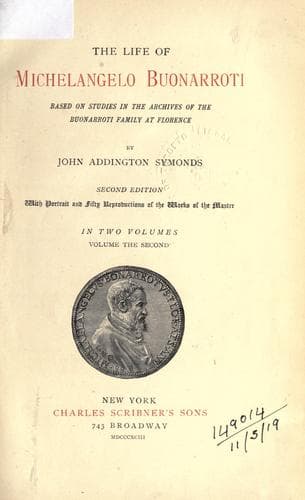
The Life of Michelangelo BuonarrotiSymonds, John Addington
History
The Life of Michelangelo Buonarroti
Symonds, John Addington
Michelangelo Buonarroti, 1475-1564
Michelangelo, being a true artist, anxious only for the presentation
of his subject, seems to have remained indifferent to its moral
quality. Whether it was a crucifixion, or a congress of the swan with
Leda, or a rape of Ganymede, or the murder of Holofernes in his tent,
or the birth of Eve, he sought to seize the central point in the
situation, and to accentuate its significance by the inexhaustible
means at his command for giving plastic form to an idea. Those,
however, who have paid attention to his work will discover that he
always found emotional quality corresponding to the nature of the
subject. His ways of handling religious and mythological motives
differ in sentiment, and both are distinguished from his treatment of
dramatic episodes. The man's mind made itself a mirror to reflect the
vision gloating over it; he cared not what that vision was, so long as
he could render it in lines of plastic harmony, and express the utmost
of the feeling which the theme contained.
Among the many statues left unfinished by Michelangelo is one
belonging to this period of his life. "In order to ingratiate himself
with Baccio Valori," says Vasari, "he began a statue of three cubits
in marble. It was an Apollo drawing a shaft from his quiver. This he
nearly finished. It stands now in the chamber of the Prince of
Florence; a thing of rarest beauty, though not quite completed." This
noble piece of sculpture illustrates the certainty and freedom of the
master's hand. Though the last touches of the chisel are lacking,
every limb palpitates and undulates with life. The marble seems to be
growing into flesh beneath the hatched lines left upon its surface.
The pose of the young god, full of strength and sinewy, is no less
admirable for audacity than for ease and freedom. Whether Vasari was
right in his explanation of the action of this figure may be
considered more than doubtful. Were we not accustomed to call it an
Apollo, we should rather be inclined to class it with the Slaves of
the Louvre, to whom in feeling and design it bears a remarkable
resemblance. Indeed, it might be conjectured with some probability
that, despairing of bringing his great design for the tomb of Julius
to a conclusion, he utilised one of the projected captives for his
present to the all-powerful vizier of the Medicean tyrants. It ought,
in conclusion, to be added, that there was nothing servile in
Michelangelo's desire to make Valori his friend. He had accepted the
political situation; and we have good reason, from letters written at
a later date by Valori from Rome, to believe that this man took a
sincere interest in the great artist. Moreover, Varchi, who is
singularly severe in his judgment on the agents of the Medici,
expressly states that Baccio Valori was "less cruel than the other
Palleschi, doing many and notable services to some persons out of
kindly feeling, and to others for money (since he had little and spent
Public-domain text, read in full here on John Shaqi.
Reviews
Reviews
No reviews yet
Be the first to share your thoughts on this work.
Elsewhere in the archive
Join the Discussion
Join the discussion
Sign in to leave a comment or review.
Sign InorCreate an account