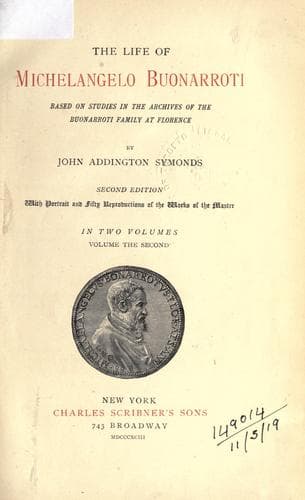
The Life of Michelangelo BuonarrotiSymonds, John Addington
History
The Life of Michelangelo Buonarroti
Symonds, John Addington
Michelangelo Buonarroti, 1475-1564
_Thou'rt dead of dying, and art made divine,
Nor fearest now to change or life or will;
Scarce without envy can I call this thine.
Fortune and time beyond your temple-sill
Dare not advance, by whom is dealt for us
A doubtful gladness, and too certain ill.
Cloud is there none to dim you glorious:
The hours distinct compel you not to fade:
Nor chance nor fate o'er you are tyrannous.
Your splendour with the night sinks not in shade,
Nor grows with day, howe'er that sun ride high
Which on our mortal hearts life's heat hath rayed.
Thus from thy dying I now learn to die,
Dear father mine! In thought I see thy place,
Where earth but rarely lets men climb the sky._
_Not, as some deem, is death the worst disgrace
For one whose last day brings him to the first,
The next eternal throne to God's by grace.
There by God's grace I trust that thou art nursed,
And hope to find thee, If but my cold heart
High reason draw from earthly slime accursed._
CHAPTER X
I
The collegiate church of S. Lorenzo at Florence had long been
associated with the Medicean family, who were its most distinguished
benefactors, Giovanni d'Averardo de' Medici, together with the heads
of six other Florentine houses, caused it to be rebuilt at the
beginning of the fifteenth century. He took upon himself the entire
costs of the sacristy and one chapel; it was also owing to his
suggestion that Filippo Brunelleschi, in the year 1421, designed the
church and cloister as they now appear. When he died, Giovanni was
buried in its precincts, while his son Cosimo de' Medici, the father
of his country, continued these benevolences, and bestowed a capital
of 40,000 golden florins on the Chapter. He too was buried in the
church, a simple monument in the sacristy being erected to his memory.
Lorenzo the Magnificent followed in due course, and found his last
resting-place at S. Lorenzo.
We have seen in a previous chapter how and when Leo X. conceived the
idea of adding a chapel which should serve as mausoleum for several
members of the Medicean family at S. Lorenzo, and how Clement
determined to lodge the famous Medicean library in a hall erected over
the west side of the cloister. Both of these undertakings, as well as
the construction of a façade for the front of the church, were
assigned to Michelangelo. The ground plan of the monumental chapel
corresponds to Brunelleschi's sacristy, and is generally known as the
Sagrestia Nuova. Internally Buonarroti altered its decorative
panellings, and elevated the vaulting of the roof into a more
ambitious cupola. This portion of the edifice was executed in the
rough during his residence at Florence. The façade was never begun in
earnest, and remains unfinished. The library was constructed according
to his designs, and may be taken, on the whole, as a genuine specimen
of his style in architecture.
Public-domain text, read in full here on John Shaqi.
Reviews
Reviews
No reviews yet
Be the first to share your thoughts on this work.
Elsewhere in the archive
Join the Discussion
Join the discussion
Sign in to leave a comment or review.
Sign InorCreate an account