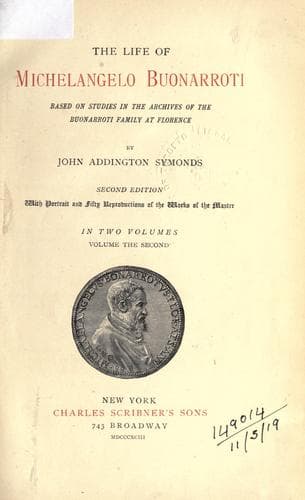
The Life of Michelangelo BuonarrotiSymonds, John Addington
History
The Life of Michelangelo Buonarroti
Symonds, John Addington
Michelangelo Buonarroti, 1475-1564
Vasari, in a well-known passage of his Life of Michelangelo, reports
the general opinion of his age regarding the novelties introduced by
Buonarroti into Italian architecture. The art of building was in a
state of transition. Indeed, it cannot be maintained that the
Italians, after they abandoned the traditions of the Romanesque
manner, advanced with certitude on any line of progress in this art.
Their work, beautiful as it often is, ingenious as it almost always
is, marked invariably by the individuality of the district and the
builder, seems to be tentative, experimental. The principles of the
Pointed Gothic style were never seized or understood by Italian
architects. Even such cathedrals as those of Orvieto and Siena are
splendid monuments of incapacity, when compared with the Romanesque
churches of Pisa, S. Miniato, S. Zenone at Verona, the Cathedral of
Parma. The return from Teutonic to Roman standards of taste, which
marked the advent of humanism, introduced a hybrid manner. This, in
its first commencement, was extremely charming. The buildings of Leo
Battista Alberti, of Brunelleschi, and of Bramante are distinguished
by an exquisite purity and grace combined with picturesqueness. No
edifice in any style is more stately, and at the same time more
musical in linear proportions, than the Church of S. Andrea at Mantua.
The Cappella dei Pazzi and the Church of S. Spirito at Florence are
gems of clear-cut and harmonious dignity. The courtyard of the
Cancelleria at Rome, the Duomo at Todi, show with what supreme ability
the great architect of Casteldurante blended sublimity with suavity,
largeness and breadth with naïveté and delicately studied detail. But
these first endeavours of the Romantic spirit to assimilate the
Classic mannerism--essays no less interesting than those of Boiardo in
poetry, of Botticelli in painting, of Donatello and Omodei in
sculpture--all of them alike, whether buildings, poems, paintings, or
statues, displaying the genius of the Italic race, renascent,
recalcitrant against the Gothic style, while still to some extent
swayed by its influence (at one and the same time both Christian and
chivalrous, Pagan and precociously cynical; yet charmingly fresh,
unspoiled by dogma, uncontaminated by pedantry)--these first
endeavours of the Romantic spirit to assimilate the Classic mannerism
could not create a new style representative of the national life. They
had the fault inherent in all hybrids, however fanciful and graceful.
They were sterile and unprocreative. The warring elements, so deftly
and beautifully blent in them, began at once to fall asunder. The San
Galli attempted to follow classical precedent with stricter severity.
Some buildings of their school may still be reckoned among the purest
which remain to prove the sincerity of the Revival of Learning. The
Sansovini exaggerated the naïveté of the earlier Renaissance manner,
and pushed its picturesqueness over into florid luxuriance or
decorative detail.
Public-domain text, read in full here on John Shaqi.
Reviews
Reviews
No reviews yet
Be the first to share your thoughts on this work.
Elsewhere in the archive
Join the Discussion
Join the discussion
Sign in to leave a comment or review.
Sign InorCreate an account