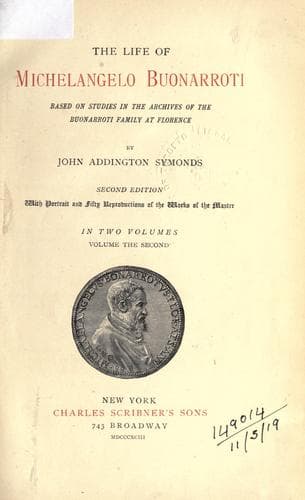
The Life of Michelangelo BuonarrotiSymonds, John Addington
History
The Life of Michelangelo Buonarroti
Symonds, John Addington
Michelangelo Buonarroti, 1475-1564
"Well, if the treasure bequeathed you by Pope Julius, in order that
you might deposit his ashes in an urn of your own carving, was not
enough to make you keep your plighted word, what can I expect from
you? It is not your ingratitude, your avarice, great painter, but the
grace and merit of the Supreme Shepherd, which decide his fame. God
wills that Julius should live renowned for ever in a simple tomb,
inurned in his own merits, and not in some proud monument dependent on
your genius. Meantime, your failure to discharge your obligations is
reckoned to you as an act of thieving.
"Our souls need the tranquil emotions of piety more than the lively
impressions of plastic art. May God, then, inspire his Holiness Paul
with the same thoughts as he instilled into Gregory of blessed memory,
who rather chose to despoil Rome of the proud statues of the Pagan
deities than to let their magnificence deprive the humbler images of
the saints of the devotion of the people.
"Lastly, when you set about composing your picture of the universe and
hell and heaven, if you had steeped your heart with those suggestions
of glory, of honour, and of terror proper to the theme which I
sketched out and offered to you in the letter I wrote you and the
whole world reads, I venture to assert that not only would nature and
all kind influences cease to regret the illustrious talents they
endowed you with, and which to-day render you, by virtue of your art,
an image of the marvellous: but Providence, who sees all things, would
herself continue to watch over such a masterpiece, so long as order
lasts in her government of the hemispheres.
"Your servant,
"The Aretine.
"Now that I have blown off some of the rage I feel against you for the
cruelty you used to my devotion, and have taught you to see that,
while you may be divine, I am not made of water, I bid you tear up
this letter, for I have done the like, and do not forget that I am one
to whose epistles kings and emperors reply.
"To the great Michelangelo Buonarroti in Rome."
The malignancy of this letter is only equalled by its stylistic
ingenuity. Aretino used every means he could devise to wound and
irritate a sensitive nature. The allusion to Raffaello, the comparison
of his own pornographic dialogues with the Last Judgment in the
Sistine, the covert hint that folk gossiped about Michelangelo's
relations to young men, his sneers at the great man's exclusiveness,
his cruel insinuations with regard to the Tomb of Julius, his devout
hope that Paul will destroy the fresco, and the impudent eulogy of his
precious letter on the Last Day, were all nicely calculated to annoy.
Whether the missive was duly received by Buonarroti we do not know.
Gaye asserts that it appears to have been sent through the post. He
discovered it in the Archives of the Strozzi Palace.
Public-domain text, read in full here on John Shaqi.
Reviews
Reviews
No reviews yet
Be the first to share your thoughts on this work.
Elsewhere in the archive
Join the Discussion
Join the discussion
Sign in to leave a comment or review.
Sign InorCreate an account