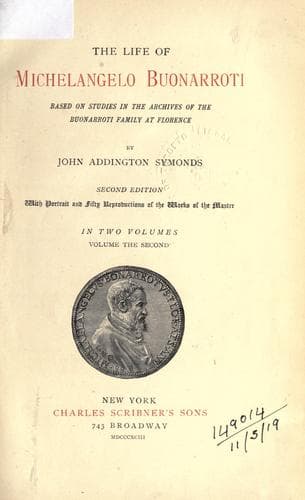
The Life of Michelangelo BuonarrotiSymonds, John Addington
History
The Life of Michelangelo Buonarroti
Symonds, John Addington
Michelangelo Buonarroti, 1475-1564
Contemplative Life to Raffaello or to any other sculptor who may be
preferred by the Duke. Finally, he is prepared to deposit a sum of
1200 crowns for the total costs, and to guarantee that the work shall
be efficiently executed in all its details.
It is curious that in this petition and elsewhere no mention is made
of what might be considered the most important portion of the
tomb--namely, the portrait statue of Julius.
The document was presented to Messer Piero Giovanni Aliotti, Bishop of
Forli, and keeper of the wardrobe to Pope Paul. Accordingly, the final
contract regarding the tomb was drawn up and signed upon the 20th of
August. I need not recapitulate its terms, for I have already printed
a summary of them in a former chapter of this work. Suffice it to say
that Michelangelo was at last released from all active responsibility
with regard to the tomb, and that the vast design of his early manhood
now dwindled down to the Moses. To Raffaello da Montelupo was left the
completion of the remaining five statues.
This lamentable termination to the cherished scheme of his lifetime
must have preyed upon Michelangelo's spirits. The letters in which he
alludes to it, after the contract had been signed, breathe a spirit of
more than usual fretfulness. Moreover, the Duke of Urbino now delayed
to send his ratification, by which alone the deed could become valid.
In October, writing to Del Riccio, Michelangelo complains that Messer
Aliotti is urging him to begin painting in the chapel; but the plaster
is not yet fit to work on. Meanwhile, although he has deposited 1400
crowns, "which would have kept him working for seven years, and would
have enabled him to finish two tombs," the Duke's ratification does
not come. "It is easy enough to see what that means without writing it
in words! Enough; for the loyalty of thirty-six years, and for having
given myself of my own free will to others, I deserve no better.
Painting and sculpture, labour and good faith, have been my ruin, and
I go continually from bad to worse. Better would it have been for me
if I had set myself to making matches in my youth! I should not be in
such distress of mind.... I will not remain under this burden, nor be
vilified every day for a swindler by those who have robbed my life and
honour. Only death or the Pope can extricate me." It appears that at
this time the Duke of Urbino's agents were accusing him of having lent
out moneys which he had received on account for the execution of the
monument. Then follows, in the same month of October, that stormy
letter to some prelate, which is one of the most weighty
autobiographical documents from the hand of Michelangelo in our
possession.
Public-domain text, read in full here on John Shaqi.
Reviews
Reviews
No reviews yet
Be the first to share your thoughts on this work.
Elsewhere in the archive
Join the Discussion
Join the discussion
Sign in to leave a comment or review.
Sign InorCreate an account