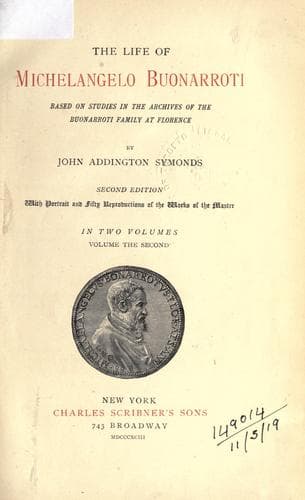
The Life of Michelangelo BuonarrotiSymonds, John Addington
History
The Life of Michelangelo Buonarroti
Symonds, John Addington
Michelangelo Buonarroti, 1475-1564
With all his good-will, however, Michelangelo did not wholly extricate
himself from the anxieties of this miserable affair. As late as the
year 1553, Annibale Caro wrote to Antonio Gallo entreating him to
plead for the illustrious old man with the Duke of Urbino. "I assure
you that the extreme distress caused him by being in disgrace with his
Excellency is sufficient to bring his grey hairs to the grave before
his time."
VI
The Tomb of Julius, as it now appears in the Church of S. Pietro in
Vincoli in Rome, is a monument composed of two discordant parts, by
inspecting which a sympathetic critic is enabled to read the dreary
history of its production. As Condivi allows, it was a thing
"rattoppata e rifatta," patched together and hashed up.
The lower half represents what eventually survived from the grandiose
original design for one façade of that vast mount of marble which was
to have been erected in the Tribune of St. Peter's. The socles, upon
which captive Arts and Sciences were meant to stand, remain; but
instead of statues, inverted consoles take their places, and lead
lamely up to the heads and busts of terminal old men. The pilasters of
these terms have been shortened. There are four of them, enclosing two
narrow niches, where beautiful female figures, the Active Life and the
Contemplative Life, still testify to the enduring warmth and vigour of
the mighty sculptor's genius. As single statues duly worked into a
symmetrical scheme, these figures would be admirable, since grace of
line and symbolical contrast of attitude render both charming. In
their present position they are reduced to comparative insignificance
by heavy architectural surroundings. The space left free between the
niches and the terms is assigned to the seated statue of Moses, which
forms the main attraction of the monument, and of which, as a
masterpiece of Michelangelo's best years, I shall have to speak later
on.
The architectural plan and the surface decoration of this lower half
are conceived in a style belonging to the earlier Italian Renaissance.
Arabesques and masks and foliated patterns adorn the flat slabs. The
recess of each niche is arched with a concave shell. The terminal
busts are boldly modelled, and impose upon the eye. The whole is rich
in detail, and, though somewhat arid in fanciful invention, it carries
us back to the tradition of Florentine work by Mino da Fiesole and
Desiderio da Settignano.
Public-domain text, read in full here on John Shaqi.
Reviews
Reviews
No reviews yet
Be the first to share your thoughts on this work.
Elsewhere in the archive
Join the Discussion
Join the discussion
Sign in to leave a comment or review.
Sign InorCreate an account