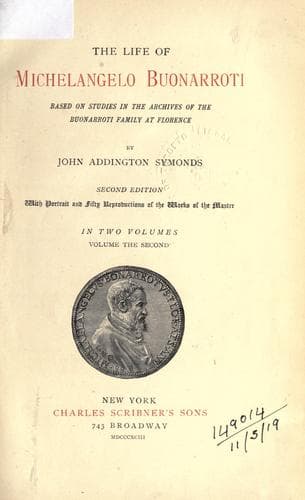
The Life of Michelangelo BuonarrotiSymonds, John Addington
History
The Life of Michelangelo Buonarroti
Symonds, John Addington
Michelangelo Buonarroti, 1475-1564
It is said that Michelangelo expressed dissatisfaction with
Montelupo's execution of the two statues finally committed to his
charge, and we know from documents that the man was ill when they were
finished. Still we can hardly excuse the master himself for the cold
and perfunctory performance of a task which had such animated and
heroic beginnings. Competent judges, who have narrowly surveyed the
monument, say that the stones are badly put together, and the
workmanship is defective in important requirements of the
sculptor-mason's craft. Those who defend Buonarroti must fall back
upon the theory that weariness and disappointment made him at last
indifferent to the fate of a design which had cost him so much
anxiety, pecuniary difficulties, and frustrated expectations in past
years. He let the Tomb of Julius, his first vast dream of art, be
botched up out of dregs and relics by ignoble hands, because he was
heart-sick and out of pocket.
As artist, Michelangelo might, one thinks, have avoided the glaring
discord of styles between the upper and the lower portions of the
tomb; but sensitiveness to harmony of manner lies not in the nature of
men who rapidly evolve new forms of thought and feeling from some
older phase. Probably he felt the width and the depth of that gulf
which divided himself in 1505 from the same self in 1545, less than we
do. Forty years in a creative nature introduce subtle changes, which
react upon the spirit of the age, and provoke subsequent criticism to
keen comments and comparisons. The individual and his contemporaries
are not so well aware of these discrepancies as posterity.
The Moses, which Paul and his courtiers thought sufficient to
commemorate a single Pope, stands as the eminent jewel of this
defrauded tomb. We may not be attracted by it. We may even be repelled
by the goat-like features, the enormous beard, the ponderous muscles,
and the grotesque garments of the monstrous statue. In order to do it
justice, Jet us bear in mind that the Moses now remains detached from
a group of environing symbolic forms which Michelangelo designed.
Instead of taking its place as one among eight corresponding and
counterbalancing giants, it is isolated, thrust forward on the eye;
whereas it was intended to be viewed from below in concert with a
scheme of balanced figures, male and female, on the same colossal
scale.
Public-domain text, read in full here on John Shaqi.
Reviews
Reviews
No reviews yet
Be the first to share your thoughts on this work.
Elsewhere in the archive
Join the Discussion
Join the discussion
Sign in to leave a comment or review.
Sign InorCreate an account