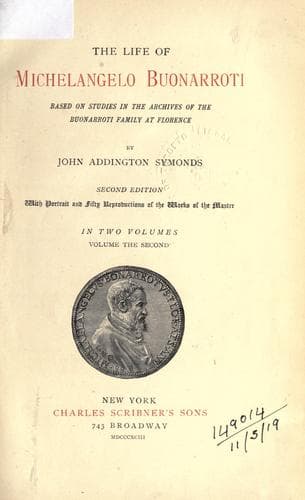
The Life of Michelangelo BuonarrotiSymonds, John Addington
History
The Life of Michelangelo Buonarroti
Symonds, John Addington
Michelangelo Buonarroti, 1475-1564
Such was the prophet when those sounding vast
Waters he held suspense about him; such
When he the sea barred, made it gulph his foe.
And you, his tribes, a vile calf did you cast?
Why not an idol worth like this so much?
To worship that had wrought you lesser woe._
VII
Before quitting the Tomb of Julius, I must discuss the question of
eight scattered statues, partly unfinished, which are supposed, on
more or less good grounds, to have been designed for this monument.
About two of them, the bound Captives in the Louvre, there is no
doubt. Michelangelo mentions these in his petition to Pope Paul,
saying that the change of scale implied by the last plan obliged him
to abstain from using them. We also know their history. When the
sculptor was ill at Rome in 1544, Luigi del Riccio nursed him in the
palace of the Strozzi. Gratitude for this hospitality induced him to
make a present of the statues to Ruberto degli Strozzi, who took them
to France and offered them to the King. Francis gave them to the
Constable de Montmorenci; and he placed them in his country-house of
Ecouen. In 1793 the Republic offered them for sale, when they were
bought for the French nation by M. Lenoir.
One of these Captives deserves to be called the most fascinating
creation of the master's genius. Together with the Adam, it may be
taken as fixing his standard of masculine beauty. He is a young man,
with head thrown back, as though in swoon or slumber; the left arm
raised above the weight of massy curls, the right hand resting on his
broad full bosom. There is a divine charm in the tranquil face, tired
but not fatigued, sad but not melancholy, suggesting that the sleeping
mind of the immortal youth is musing upon solemn dreams. Praxiteles
might have so expressed the Genius of Eternal Repose; but no Greek
sculptor would have given that huge girth to the thorax, or have
exaggerated the mighty hand with such delight in sinewy force. These
qualities, peculiar to Buonarroti's sense of form, do not detract from
the languid pose and supple rhythm of the figure, which flows down, a
sinuous line of beauty, through the slightly swelling flanks, along
the finely moulded thighs, to loveliest feet emerging from the marble.
It is impossible, while gazing on this statue, not to hear a strain of
intellectual music. Indeed, like melody, it tells no story, awakes no
desire, but fills the soul with something beyond thought or passion,
subtler and more penetrating than words.
Public-domain text, read in full here on John Shaqi.
Reviews
Reviews
No reviews yet
Be the first to share your thoughts on this work.
Elsewhere in the archive
Join the Discussion
Join the discussion
Sign in to leave a comment or review.
Sign InorCreate an account