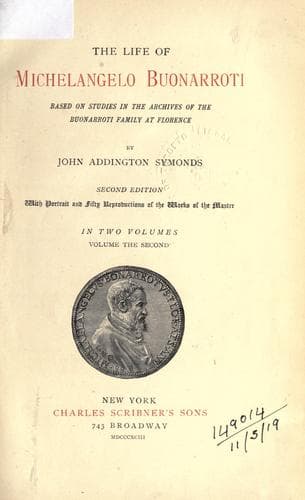
The Life of Michelangelo BuonarrotiSymonds, John Addington
History
The Life of Michelangelo Buonarroti
Symonds, John Addington
Michelangelo Buonarroti, 1475-1564
We shall see that it was his custom to mark his feeling for particular
friends by gifts of drawings as well as of poems. He did this notably
in the case of both Vittoria Colonna and Tommaso dei Cavalieri. For
the latter he designed subjects from Greek mythology; for the former,
episodes in the Passion of our Lord. "At the request of this lady,"
says Condivi, "he made a naked Christ, at the moment when, taken from
the cross, our Lord would have fallen like an abandoned corpse at the
feet of his most holy Mother, if two angels did not support him in
their arms. She sits below the cross with a face full of tears and
sorrow, lifting both her widespread arms to heaven, while on the stem
of the tree above is written this legend, 'Non vi si pensa quanto
sangue costa.' The cross is of the same kind as that which was carried
in procession by the White Friars at the time of the plague of 1348,
and afterwards deposited in the Church of S. Croce at Florence. He
also made, for love of her, the design of a Jesus Christ upon the
cross, not with the aspect of one dead, as is the common wont, but in
a divine attitude, with face raised to the Father, seeming to exclaim,
'Eli! Eli!' In this drawing the body does not appear to fall, like an
abandoned corpse, but as though in life to writhe and quiver with the
agony it feels."
Of these two designs we have several more or less satisfactory
mementoes. The Pietà was engraved by Giulio Bonasoni and Tudius
Bononiensis (date 1546), exactly as Condivi describes it. The
Crucifixion survives in a great number of pencil-drawings, together
with one or two pictures painted by men like Venusti, and many early
engravings of the drawings. One sketch in the Taylor Museum at Oxford
is generally supposed to represent the original designed for Vittoria.
II
What remains of the correspondence between Michelangelo and the
Marchioness opens with a letter referring to their interchange of
sonnets and drawings. It is dated Rome, 1545. Vittoria had evidently
sent him poems, and he wishes to make her a return in kind: "I
desired, lady, before I accepted the things which your ladyship has
often expressed the will to give me--I desired to produce something
for you with my own hand, in order to be as little as possible
unworthy of this kindness. I have now come to recognise that the grace
of God is not to be bought, and that to keep it waiting is a grievous
sin. Therefore I acknowledge my error, and willingly accept your
favours. When I possess them, not indeed because I shall have them in
my house, but for that I myself shall dwell in them, the place will
seem to encircle me with Paradise. For which felicity I shall remain
ever more obliged to your ladyship than I am already, if that is
possible.
"The bearer of this letter will be Urbino, who lives in my service.
Your ladyship may inform him when you would like me to come and see
the head you promised to show me."
Public-domain text, read in full here on John Shaqi.
Reviews
Reviews
No reviews yet
Be the first to share your thoughts on this work.
Elsewhere in the archive
Join the Discussion
Join the discussion
Sign in to leave a comment or review.
Sign InorCreate an account