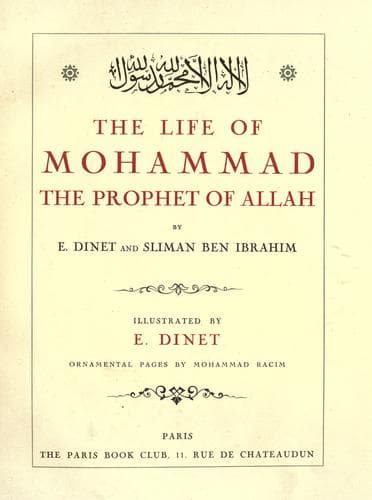
The Life of Mohammad, the Prophet of AllahDinet, Etienne
Religion
The Life of Mohammad, the Prophet of Allah
Dinet, Etienne
Muhammad, Prophet, -632
By this he meant to inform Ura that these infidels, now dwelling in
hell, were compelled to acknowledge the truth of words that he had
ofttimes repeated to them when they were in the land of the living.
Thus does a "hadis" of Ayishah explain this scene, for it is said in
the Qur'an: "_Verily then, thou canst make the dead to bear._" (XXX,
51). The Believers only lost fourteen men, six Mohadjirun and eight
Ansars, winning eternal glory as the first fallen in the Holy War.
[Sidenote: THE SOJOURN AT BADR AND THE RETURN TO AL-MADINAH]
The Prophet remained three days on the field of battle to bury the
dead and gather together the booty which he left to be guarded by the
family of the Najjar. He then got ready to go back to Al-Madinah.
Two couriers, Zayd, his adopted son, and Ibn-i-Ruhah, sent on to carry
the glad tidings, reached there before him. They arrived at the moment
when the situation of the Believers in the city was becoming critical.
Gravediggers had not finished cleansing their hands from the earth
with which they had just covered the last resting-place of Roghaid,
Mohammad's daughter, married to Usman. She had been carried off by
painful illness. "Hypocrites" and Jews put the most alarming rumours
in circulation concerning the Prophet's fate and they were getting
ready to attack his supporters....
The good news spread all over the town with lightning-like rapidity;
causing confusion in the haunts of "Hypocrites" and Jews; reassuring
the Faithful and causing great enthusiasm in their ranks. All of
them--a vast crowd of men, women and children--went forth to acclaim
the conqueror, the procession marching to the cadence of drums. They
sang in chorus the chant with which he had been welcomed when he first
arrived: "The full moon hath risen above our head--Emerging from the
Sanniyat-ul-Wida;--Numerous are the thanksgivings we must offer up to
Allah--With the purest fervour of our supplications.--O thou His
Messenger among us--The orders thou dost bring us shall be piously
executed!"
Ever since this battle, for ever memorable, which by its results
eventually changed the whole face of the world, although only fought
out by a small number of men, the Wadi of Badr is visited yearly by
thousands of pilgrims.
It is written by the traveller Abul Hosain ibn Zubair. "A small
market-town, surrounded by ramparts, stands now upon its site ... What
was once the well where the Unbelievers were buried, is now a clump of
palm-trees, and a little farther off are the tombs of the martyrs.
"To the left of the road leading from Safra, is the Mountain of
Mercy--Ar Rahman--by which the Angels descended from Heaven.
"The "arish," the shelter where Mohammad stood, is said to have been
erected on the slope of a sandhill, called Jabl-ul-Tabl, the Mountain
of the Drum, because the roll of supernatural drums is frequently
heard there by pilgrims; this mysterious martial music celebrating the
remembrance of the first victory of Islam."
Public-domain text, read in full here on John Shaqi.
Reviews
Reviews
No reviews yet
Be the first to share your thoughts on this work.
Elsewhere in the archive
Join the Discussion
Join the discussion
Sign in to leave a comment or review.
Sign InorCreate an account