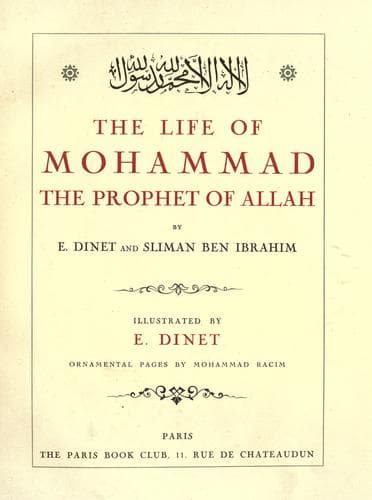
The Life of Mohammad, the Prophet of AllahDinet, Etienne
Religion
The Life of Mohammad, the Prophet of Allah
Dinet, Etienne
Muhammad, Prophet, -632
Among the prisoners was Abul' As ibn Rabiyah, a rich man in high
repute. He had married Zainab, the daughter of the Prophet, before the
Revelation, and was still an idolater. For the ransom of her husband,
Zainab sent from Makkah a sum of money and a necklace, a wedding-gift
from her mother Khadijah. The Prophet, recognising this piece of
jewellery which he had ofttimes seen round the neck of his beloved and
regretted Khadijah, was unable to repress his emotion and put this
question to his disciples: 'If ye do not oppose me, I will send her
husband back to Zainab, and renounce all claims to ransom.' No
objection being raised, Mohammad told his prisoner that he was free.
'But only on one condition. Restore my daughter to my arms, for a
woman of the Mussulmans cannot remain in the power of an idolater.'
The captive accepted most reluctantly, and as soon as he was again in
Makkah, he kept his word.
The Quraish, however, hearing of Zainab's departure, started off in
pursuit of her, and one of them, Hibar, struck her so brutally with
the shaft of his spear, that he threw her out of her "hawdaj," (a kind
of litter), and she dropped from the back of her camel to the ground.
Shortly after her arrival at Al-Madinah, the poor woman, not having
recovered from her fall, and being pregnant, died from the effects of
the ill-treatment she had thus undergone.
Under the influence of grief and despair, the Prophet gave orders that
anyone putting his hand on the villain Hibar was to burn him alive.
But it was not long before Mohammad cancelled this cruel command,
declaring: 'The Master of the Worlds alone hath the right to inflict
the torture of Fire!' This was in allusion to the flames of Hell.
As for Abul'As, retaken by the Mussulmans while conducting a caravan
back from Syria-, he was again liberated by the Prophet and became a
convert to Islam.
Mohammad thus let no opportunity escape to prove his generosity to the
prisoners, his own fellow-countrymen. The Prophet's clemency resulted
immediately in the conversion of no small number of Makkans,
marvelling at the tales told by the captives who, upon regaining the
bosom of their families, bore witness to the kindness with which they
had been treated.
Perhaps the fact of such compassion towards the enemies of Islam
constituted peril in the future? So said a Revelation to the Prophet,
blaming him at the same time. Mohammad was overwhelmed with profound
sadness, at the thought that his generosity would cause the death of
many Believers, as he dared not hope that goodness would sweep away
all feeling of enmity.
Public-domain text, read in full here on John Shaqi.
Reviews
Reviews
No reviews yet
Be the first to share your thoughts on this work.
Elsewhere in the archive
Join the Discussion
Join the discussion
Sign in to leave a comment or review.
Sign InorCreate an account