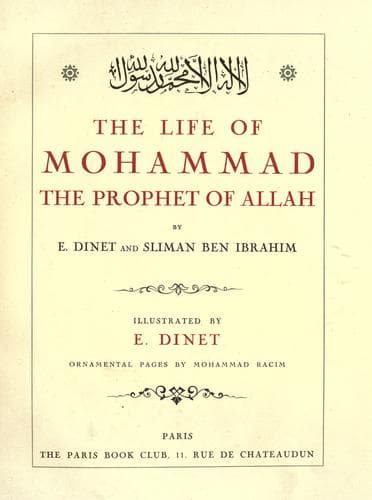
The Life of Mohammad, the Prophet of AllahDinet, Etienne
Religion
The Life of Mohammad, the Prophet of Allah
Dinet, Etienne
Muhammad, Prophet, -632
From the top of their ramparts, the dwellers in Al-Madinah looked down
on a sight that made their agriculturists' hearts bleed. Like a swarm
of gigantic locusts, the camels of the idolatrous army ravaged the
verdant meadows, whilst horsemen slaughtered cattle and, madly
rushing, the riders trampled down and scattered the golden harvest,
with all the disdain of traders for the work of husbandmen.
In the face of this havoc wrought before their eyes, the Faithful
found themselves in a state of most irritating powerlessness. The
plain afforded commodious space for the manoeuvres of their enemies'
countless cavalry, and the Believers had no mounted men to put in the
field.... Their sole resource was the wisdom of Allah's Apostle; so,
ready for any sacrifice, they gathered round him.
Now Mohammad had dreamed that he saw his sword-blade notched; his foes
slaughtering his flocks, whilst a breastplate was close to his hand.
The Prophet told his followers of his dream and explained what it
signified. 'The notched blade means that I shall be wounded. The
slaughtered flocks show that a great number of my disciples will die;
and the breastplate near me symbolizes the ramparts of Al-Madinah
which alone can save us from disaster. Let us shut ourselves up in the
city and we shall have nothing to fear from our adversaries. Should
they attack, they can easily be repulsed and made to suffer cruel
losses; and if they fall back without attacking, they will be crushed
in their retreat by the shame of not having dared to fight us.'
Such had always been the tactics of the people of Al-Madinah from time
immemorial; but their quality of Mussulmans and their victory at the
battle of Badr had changed all their ideas. Thinking that they were
now and for ever invincible, they no longer had the patience to remain
impassible while their gardens were laid waste. Furthermore, those who
had not fought at Badr were burning with desire to show that they too
were full of courage. The worst that could befall them was martyrdom
to which they sincerely aspired.
Abdullah ibn Abi Salul, chief of the "Hypocrites," was alone opposed
to an advance. For once in a way, the Prophet agreed with him.
Nevertheless, in the face of the unanimity and the enthusiasm of the
true Believers, Mohammad considered that he ought to give way, and
resolved to order the march out that he disapproved in his foresight.
After having recited the afternoon prayer, _Asr_, he went back into
his house to buckle on his armour.
The warriors, too, were ready. A compact crowd surrounded the dwelling
of the Prophet who soon appeared, girt with his coat of mail, helmet
on head, sword by his side, shield on his shoulders, and spear in
hand....
Public-domain text, read in full here on John Shaqi.
Reviews
Reviews
No reviews yet
Be the first to share your thoughts on this work.
Elsewhere in the archive
Join the Discussion
Join the discussion
Sign in to leave a comment or review.
Sign InorCreate an account