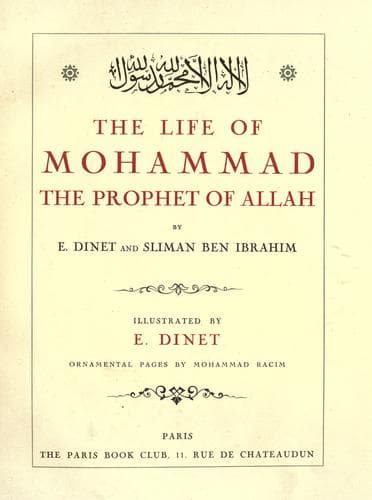
The Life of Mohammad, the Prophet of AllahDinet, Etienne
Religion
The Life of Mohammad, the Prophet of Allah
Dinet, Etienne
Muhammad, Prophet, -632
Among the enemy was an inhabitant of Medinah, Abu Amir, converted to
Christianity and nicknamed "Ar Rahib," which means "the Monk." Having
got into his head that he could lead a few of his fellow-countrymen in
the Aus tribe astray from the cause of Islam, he went and stood before
them, saying: 'O "qawm" of the Aus! 'tis I, Abu Amir, a son of your
soul. Will ye not hear me out?'--'May Allah refuse thee all favour, O
scoundrel!' they replied. Choking with shame and rancour, "the Monk"
went away, after picking up a pebble which he threw in fury at them.
When "the Monk" had retired, an idolater of terrible appearance,
bestriding a gigantic camel, advances; challenging the Believers
thrice. At the third provocation, Zubayr stepped out of the ranks.
With the leap of a panther, he sprang on to the camel's rump, threw
his arms round his adversary, and rolling with him on the ground,
never let go his hold until he had torn his throat open.
Seeing the combat beginning, Abu Dujana could restrain himself no
longer. He drew his sword. 'There is no good fortune in the ranks of
cowards!' he exclaimed. 'I strike with the sword of Allah and His
Prophet!' The scarlet turban was seen digging into the very centre of
the enemy's massed troops like a glowing brand.
By dint of prodigies of audacity, he struck down all those he met on
his way, when suddenly he found himself facing a strange being who,
vomiting forth the vilest blasphemy, was followed by a crowd of girls
playing on tabors. Abu Dujana brandished his blade over his
adversary's head, but on hearing the piercing shrieks uttered by Hind,
he recognised her. The sword of the Prophet was rendered generous by
him, for he knew it ought not to strike a woman.
Following Abu Dujana's onslaught, the battle raged furiously and all
the combatants were at grips. Arshah, the Quraish standard-bearer, was
struck down by Hamzah, and showed all his teeth in the snarling grin
of death. Siba-al-Ghassani picked up the flag, and challenged his
companion's conqueror. 'Come a little nearer, O son of the procuress!'
replied Hamzah; and at a single stroke, he made him share the fate of
Arshah.
Wishing to avenge his uncle Tahaimah, slain at Badr by Hamzah, Zubayr
ibn Mutam promised to free his Abyssininan slave, Al-Uhayha, if he
succeeded in killing Hamzah.
Public-domain text, read in full here on John Shaqi.
Reviews
Reviews
No reviews yet
Be the first to share your thoughts on this work.
Elsewhere in the archive
Join the Discussion
Join the discussion
Sign in to leave a comment or review.
Sign InorCreate an account