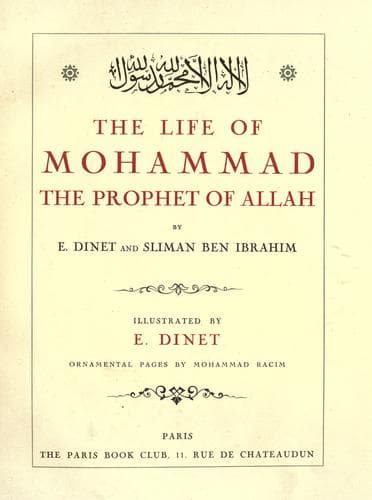
The Life of Mohammad, the Prophet of AllahDinet, Etienne
Religion
The Life of Mohammad, the Prophet of Allah
Dinet, Etienne
Muhammad, Prophet, -632
It was then, seeing his brave warriors beginning to stagger, that he
called a halt. All his men, worn out by fatigue, dropped on the
ground, overcome by deep sleep where they fell, without having been
able to give vent to the feelings of fury seething in their hearts and
which might have caused most sanguinary conflicts among them.
The "Hypocrite" Abdullah had a son who was also called Abdullah. He
was a sincere Believer and he went to the Prophet. 'They tell me,'
quoth the young man, 'that thou didst intend to kill Abdullah, my
father. In that case, charge me to bring thee his head, for by Allah!
thou shalt know that among the Khazraj, there is no son more devoted
to his father than I. If thou shouldst charge any other to execute
him, I should not be able to bear the sight of his murderer going
unpunished and I should kill him. Therefore I should be slaying a true
Mussulman in order to avenge a Mussulman "Hypocrite," and render
myself deserving of hell-fire.'
The Prophet tranquilised the stoical Believer by these words: 'Give no
credit to what thou didst hear. On the contrary, we look upon thy
father as our friend and comrade, so long as he remaineth with us.'
[Sidenote: THE TAYANNUM, OR THE CEREMONY OF ABLUTION PERFORMED WITH
SAND]
It was during this expedition that the following Revelation came down:
"_But if ye are sick, or on a journey, or if one of you come from the
place of retirement, or if ye have touched women and find no water,
then take clean sand and rub your faces and your hands with it._" (THE
QUR'AN, V, 9.)
Thus was established the Tayammum, or purification by sand, destined
to prevent the Believers from ever forgetting their salutary duty; for
this did away with the pretext, so frequent in their deserts, that
lack of water hindered the performance of ablutions.
[Sidenote: THE BATTLE OF THE DITCH (_Year V of the Hegira, A.D. 627_)]
A deputation of Jews from the tribe of the Banu Nazir, and a few
malcontents of the Wayls journeyed to Makkah to offer the Quraish an
alliance. The Ghatafans, a tribe hailing from the north of the Hijaz,
and the "Habash," or Arab Confederates, joined them. Thus was
organised a vast conspiracy, threatening Al-Madinah on all sides.
This time, when the Prophet got to hear of the importance of this
expedition, he had no difficulty in persuading the Believers that the
only way to save themselves was by entrenchment in the town and there
awaiting the advent of the enemy.
Public-domain text, read in full here on John Shaqi.
Reviews
Reviews
No reviews yet
Be the first to share your thoughts on this work.
Elsewhere in the archive
Join the Discussion
Join the discussion
Sign in to leave a comment or review.
Sign InorCreate an account