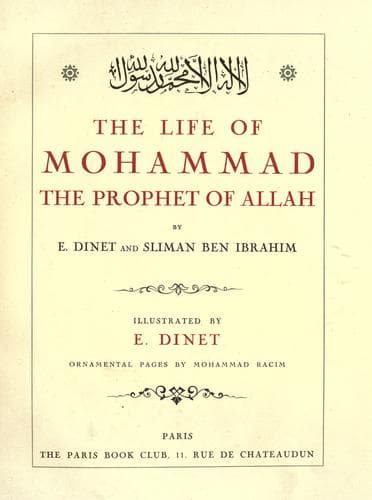
The Life of Mohammad, the Prophet of AllahDinet, Etienne
Religion
The Life of Mohammad, the Prophet of Allah
Dinet, Etienne
Muhammad, Prophet, -632
The palm-gardens of Khaibar, spreading between the sombre heights of
the Harra like an emerald lake whence emerged rocky, citadel-crowned
islets, came suddenly into view, after passing through a ravine. To be
able to take possession of them, the Prophet invoked the aid of the
Almighty. But night coming on, Mohammad postponed the attack till the
following day. When the first rays of the sun gilded the tops of the
date-trees, the Khaibar husbandmen left their strongholds to go in
their gardens; their spades, pickaxes and baskets hanging from their
shoulders. Suddenly, they found themselves confronted by the
Believers' army debouching from the Harra; spearheads and swords
reflecting the light of the rising sun in ensanguined radiance.
'Mohammad and his Jihsh!' they cried, and throwing away implements and
baskets, fled as fast as their legs would carry them. 'Allah is
great!' proclaimed the Prophet. 'Khaibar shall be destroyed. When we
swoop down on the territory of a nation, its awakening is terrible! Lo
and behold the sinister omen! On our behalf, its inhabitants abandon
their tools that will serve to undermine their ramparts and dig their
graves.'
The first of the many Khaibar citadels to fall into the Mussulmans'
hands was that of Na'im. It was there they had to mourn the loss of
Mahmud ibn Maslama, who, tired of having fought all day in the sun,
wearing heavy armour, had imprudently gone close to the rampart to
rest in the shade. A mill-stone, hurled from an embrasure, smashed the
valiant soldier's helmet, split his skull, and caused the skin of his
forehead to fall down over his eyes. In that parlous state, the
wounded man was brought into the presence of the Prophet who put the
strip of flesh back in its place, fastening a turban round it; but the
best of attention was unavailing in face of such a serious injury, and
it was not long before Mahmud gave up the ghost.
The citadels of Natha, the next to be invested, resisted more
obstinately. In order to force the besieged to capitulate, the Prophet
gave orders to cut down under their eyes four hundred palm-trees of
their oasis, but all in vain. He therefore put an end to such
devastation, contrary to his principles, for as he has said: 'Among
all trees, there is one which is blessed like a Mussulman: 'tis the
palm.'
The siege continuing, famine began to make itself felt, discouraging
the besiegers, when Umar, having taken a Jew prisoner, the captive, to
save his life, offered to give the Prophet valuable information. In
the cellars of Sa'b ibn Mu'adh, one of the Natha citadels, called
after the man, instruments of warfare of all kinds were stored:
battering-rams; catapults for siege purposes; and armour, shields,
pikes, lances and swords for the equipment of combatants. Just then,
this fort happened to be weakly garrisoned, and the Jewish captive
undertook to take the Mussulmans inside by means of a secret itinerary
known to him alone.
Public-domain text, read in full here on John Shaqi.
Reviews
Reviews
No reviews yet
Be the first to share your thoughts on this work.
Elsewhere in the archive
Join the Discussion
Join the discussion
Sign in to leave a comment or review.
Sign InorCreate an account