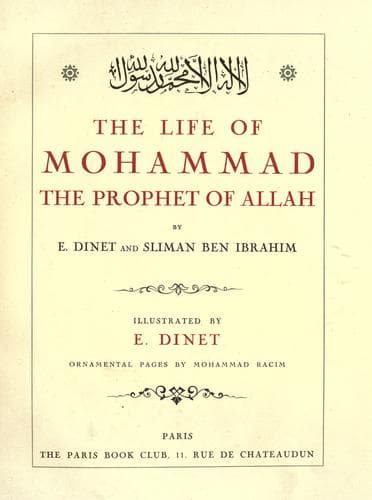
The Life of Mohammad, the Prophet of AllahDinet, Etienne
Religion
The Life of Mohammad, the Prophet of Allah
Dinet, Etienne
Muhammad, Prophet, -632
Khaibar was the most fertile land of all the Hijaz; the spoils were
therefore considerable. One half was set apart to defray the expenses
of the pilgrimage to take place during the current year; the rest was
distributed among the warriors. The land, with the exception of the
portion due to the Prophet and to orphans, was divided in such a way
that each man received one share, and each charger two shares; making
three shares for each horseman. This was done with the aim of
encouraging the breed of horses. A supplementary gift fell to the lot
of any soldier being the owner of a pure-blooded courser.
[Sidenote: IMPORTANCE OF HORSE-BREEDING ACCORDING TO THE PROPHET]
These measures show the importance attributed by the Prophet to the
equine race in the life of the Arabs.
Up till then, horses were very rare in Arabia, being looked upon as
articles of luxury, as it were. Led by the bridle by the side of the
camels ridden by the warriors, the steeds were only called upon when
charging or pursuing the enemy. The Prophet completed these
arrangements by founding race-meetings destined to develop emulation
among breeders and horsemen. In the Qur'an, so as to inspire Believers
with the fear, of the Day of Retribution, horses galloping breathless
are called to witness: "_By the panting chargers! * And those that
dash off sparks of fire * And those that scour to the attack at morn!
* And stir therein the dust aloft! * And cleave therein their midway
through a host! * Truly, Man is to his Lord ungrateful! * And of this
he verily is himself a witness * And truly he is vehement in the Love
of this world's good. * Knoweth he not, then, that when that which is
in the graves shall be torn forth * And that which is in men's breasts
shall be brought out * Verity their Lord shall on that day be well
informed concerning them?_" (THE QUR'AN, C, 1-11.)
Unfortunately, tame translation is powerless to give an idea of the
dizzy, whirling rhythm and the panting, galloping, neighing--if one
may venture so to write--assonance of the first verses of this surah.
One of the most celebrated horsemen of that epoch, Abdullah ibn Abi
Sarh, afterwards governor of Egypt and who inflicted cruel defeats on
the Romans, by land and sea, was such an enthusiastic admirer of this
surah that it was always on his lips, and he recited it even on his
deathbed.
Thanks to the vigorous impulsion given by the Prophet to
horse-breeding, the race of pure-blooded barbs unrivalled in the
world, was soon formed, to be kept up ever afterwards.
[Sidenote: THE POISONED LAMB]
Public-domain text, read in full here on John Shaqi.
Reviews
Reviews
No reviews yet
Be the first to share your thoughts on this work.
Elsewhere in the archive
Join the Discussion
Join the discussion
Sign in to leave a comment or review.
Sign InorCreate an account