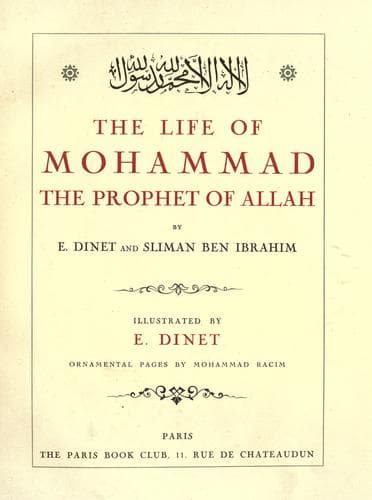
The Life of Mohammad, the Prophet of AllahDinet, Etienne
Religion
The Life of Mohammad, the Prophet of Allah
Dinet, Etienne
Muhammad, Prophet, -632
At the same time as the expeditionary forces, laden with spoils, came
back from Khaibar, the last emigrants arrived from Abyssinia. Among
them was Jafar, son of Abu Talib and brother to Ali. Their return made
Mohammad very joyful. With sincere effusion, he kissed Jafar between
the eyes and declared: 'I know not which causeth me the greatest joy:
the taking of Khaibar, or the return of Jafar.'
Among those returning was also Umm Habiba, daughter of Abu Sufyan, the
Prophet's mortal enemy. She had emigrated with her husband,
Ubaydu'llah ibn Jahsh, but he was a convert to Christianity and had
died in Abyssinia, while she remained steadfast to Islam. As a reward
for such fidelity, as well as hoping to disarm by alliance one of his
most fierce adversaries, the Prophet had sent Amr ibn Umayya to the
Negus, asking to be married by proxy to Umm Habiba and to have her
sent back afterwards with the other emigrants. This being done, Umm
Habiba, on arriving at Al-Madinah, was received in the dwelling of her
illustrious husband.
As for the emigrants, Mohammad proposed that they should be allowed a
share of the Khaibar booty. This arrangement being ratified by
unanimous consent, they were thus compensated for having sacrificed
their property and left their country in order to remain true to their
faith.
The date on which the treaty of Al-Hudaibiyah gave the Prophet the
right to come to Makkah with his disciples to visit the Holy Places
having arrived, he was now on the point of being able to fulfil one of
his most ardent aspirations and also see his native land.
Followed by the same number of pilgrims, and driving before him the
same number of camels, destined to be sacrificed, as in the expedition
of Al-Hudaibiyah, he made his partisans disarm and left in the valley
of Batn Ya'jiju, a great quantity of weapons, brought as a
precautionary measure, in the care of a guard, two hundred strong,
commanded by Aws ibn Khawli. 'We only penetrate into the Holy Land,'
declared the Prophet, 'carrying the arms of the traveller: our swords
in their scabbards, according to the terms of our oath, but if we
detect in the glances of the idolatrous Quraish the slightest sign of
treachery, our other weapons will be found handy.'
He then pushed on. Self-communing, he climbed the Kuda hill, in order
to descend into the valley near the cemetery of Al-Hajun where rested
his beloved Khadijah (May Allah welcome her in His Grace!) When he
cast eyes on the first houses of Makkah, unspeakable emotion
overpowered him by reason of the remembrances and hopes they evoked.
Fearing lest treachery, on the part of the Infidels, should force him
to order reprisals, causing the blood of his fellow-countrymen to
sully the streets of the city where he was born, he cried out: 'O
Allah, spare us all misfortune in the Holy City!' He never ceased
repeating this request until he left the precincts of Makkah.
Public-domain text, read in full here on John Shaqi.
Reviews
Reviews
No reviews yet
Be the first to share your thoughts on this work.
Elsewhere in the archive
Join the Discussion
Join the discussion
Sign in to leave a comment or review.
Sign InorCreate an account