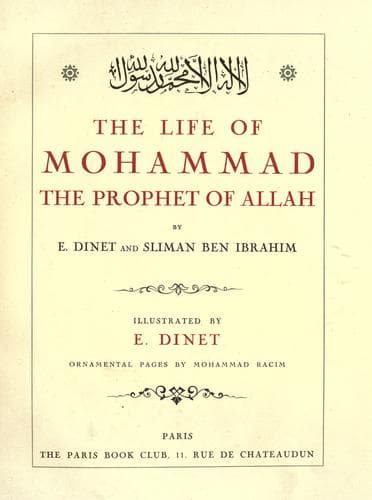
The Life of Mohammad, the Prophet of AllahDinet, Etienne
Religion
The Life of Mohammad, the Prophet of Allah
Dinet, Etienne
Muhammad, Prophet, -632
The only exceptions to this magnanimous amnesty were made in the cases
of eleven men and six women whose conduct had been inexcusable. He
ordered them to be put to death, wherever found. The sentence was
immediately carried out, and a few of the condemned were executed,
including Huwarith, who brutally ill-treated Fatimah, the Prophet's
daughter and Ali's wife, when she went away from Makkah.
In order to establish the new state of affairs firmly, Mohammad
proceeded to appoint immediately the two most important functions of
Makkah: the custodian of the Ka'bah and that of the Zamzam well.
He sent to claim the keys of the Temple from Uthman ibn Talha who,
after having in a fit of fury locked the gates, took the keys away
with him to his house. The Prophet had them torn from him forcibly,
and intended to confide them to his uncle Abbas whom he maintained at
his post as Superintendent of the Zamzam well. But a Revelation made
the Prophet alter his mind and he was ordered to reinstate the former
custodian of the Temple. Mohammad therefore charged Ali to take the
keys back to Uthman and say to him: 'O son of Talha, take the keys
once more and with them the appointment as custodian of the Ka'bah.'
This official, touched by such generosity, so little deserved,
hastened to give the Prophet the promise of sincere gratitude and
absolute fidelity.
Just then a touching group approached: there was Abu Quhafa, an old
blind man, bent beneath the burden of his eighty-seven years, and
leaning on the arm of his son, Abu Bakr. 'Why didst thou not let this
noble old man remain in his dwelling, whither I could have gone to see
him?' said the Prophet to Abu Bakr.--'It is only right that he cometh
to thee, and not that thou shouldst go to him,' replied Abu Bakr.
Mohammad made the venerable sightless man sit by his side, paying him
great attention, stroking his breast affectionately, and was overjoyed
to hear that Abu Quhafa had come to announce his conversion to the
faith of Islam.
[Sidenote: THE PROPHET AT SAFA]
Next day, all the inhabitants of Makkah wended their way towards the
hill of Safa where the Prophet had called them together to receive
their submission.
Tranquilized already by the generosity of the first utterances and
acts of their conqueror, they did not seem to be affected by the
feelings of sadness, shame and dejectedness that usually overcome the
vanquished. Was not their conqueror one of their own people? Would not
his glory become their glory; his triumph, their triumph; and his
empire, their empire? As a matter of fact, despite their hostility
towards him, most of them had suffered cruelly at being separated from
their genial fellow-countryman; the man who, in the heyday of his
youth, had been called by them: "Al-Amin," the Reliable. They were
greatly moved as they called to mind the mysterious charm of his
personality and the irresistible allurement of his speech.
Public-domain text, read in full here on John Shaqi.
Reviews
Reviews
No reviews yet
Be the first to share your thoughts on this work.
Elsewhere in the archive
Join the Discussion
Join the discussion
Sign in to leave a comment or review.
Sign InorCreate an account