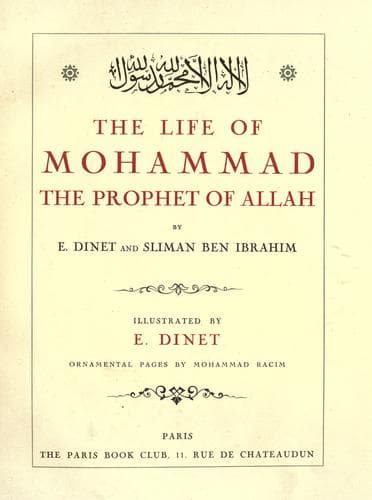
The Life of Mohammad, the Prophet of AllahDinet, Etienne
Religion
The Life of Mohammad, the Prophet of Allah
Dinet, Etienne
Muhammad, Prophet, -632
One incident, however, cast a gloom over this unforgettable
manifestation that realised so perfectly the dream which had haunted
the Prophet, filling him with superhuman perseverance. The Khuza'a,
falling across one of the murderers of their brethren, cut his throat.
Mohammad caused the guilty parties to be brought before him and, after
blaming them severely, he added: 'I will compensate your victim's
relatives myself, but cease all reprisals. Too much blood hath been
shed already. On the day when He created the Heavens and the Earth,
Allah declared the territory of Makkah to be holy; its sacred
character hath remained for all before me and shall remain for all
after me. Not only shall the lives of human beings be sacred here, but
it is likewise forbidden to hunt game, fell trees and cut grass.'--'In
this prohibition, O Prophet! the Idhkhir must be excepted,' remarked
Abbas. 'It furnisheth us with that which we cannot do without, to wit:
fuel for the forge and the cooking of food.' After a moment's silence,
the Prophet concluded: 'With the exception of the Idhkhir, which it
will be allowable to uproot.' Following this declaration, all those
condemned to death, and who had not been executed the first day, were
granted a free pardon.
Among the crowd of Makkan women who came to declared their devotion,
Mohammad's attention was drawn to a female hiding herself behind her
companions. Despite the fact that she was disguised, he recognised
ferocious Hind, the wife of Abu Sufyan. 'Aye! 'tis I!' she cried,
throwing off her veil, 'I am Hind, and I implore pardon for the past!'
The Prophet, in spite of the odious mutilation of the body of his
uncle Hamzah, forgave her. Hind, when she returned to her dwelling,
lavished insults on her private family idol: 'O impotent idol! How mad
we all were to rely on thy succour!' And she smashed it to pieces.
The son of Abu Jahal, Ikrimah, who had organised the ambush that
nearly entrapped Khalid, fled to the sea coast. The fugitive's pardon
was granted to Umm Hakim, his wife, who rejoined him when he was on
the point of embarking. She brought him back, and the Prophet, fearful
lest his companions, remembering how he had been so often outraged by
Abu Jahal, Ikrimah's father, might seek to be avenged on Ikrimah
personally, declared: 'Ikrimah hath come to Islam. Let no one insult
his father's memory! To insult the dead is to wound the living!' And
Ikrimah, deeply moved by such rare tolerance, became one of the most
ardent defenders of the Religion.
Public-domain text, read in full here on John Shaqi.
Reviews
Reviews
No reviews yet
Be the first to share your thoughts on this work.
Elsewhere in the archive
Join the Discussion
Join the discussion
Sign in to leave a comment or review.
Sign InorCreate an account