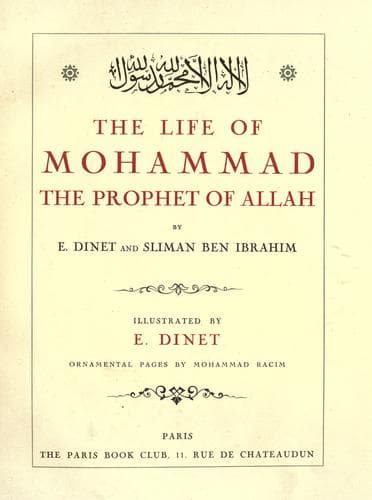
The Life of Mohammad, the Prophet of AllahDinet, Etienne
Religion
The Life of Mohammad, the Prophet of Allah
Dinet, Etienne
Muhammad, Prophet, -632
Fresh difficulties now arose, concerning the place of burial; some
wanting the grave to be dug in the Mosque; others, at Al-Baqi, among
the tombs of the Prophet's family. A few mentioned Makkah, his
birthplace. Abu Bakr silenced them, affirming that he had heard
Mohammad say: 'Allah only taketh the soul of a Prophet on the spot
where it is fitting that he should be buried.'
The bed was accordingly moved away and the grave dug in the ground
underneath it. This task was alloted to Talha, the gravedigger of
Al-Madinah. He strengthened the sides of the grave by means of nine
unburnt bricks, and carpeted the bottom with the red blanket that
served the Prophet as a rug for his camel when travelling, and which
was not to be used by anyone now that he was dead. Ali, Al-Fadl,
Qutham, and Shakran lowered the body into its last resting-place....
Al Mughira ibn Shu'ba affirms that he was the last man to have the
happiness of contemplating the face of the Chosen One before it was
covered with earth. "I let my finger-ring drop into the grave,' he
says, 'so that when I regained it, I should be the last to address a
farewell salute to the Prophet."
The sad ceremony was concluded in the middle of the night between
Tuesday and Wednesday. On the morrow, at dawn, when in his call to
prayer, Bilal, the "Muazzin," proclaimed: 'There is no God but Allah,
and Mohammad is the Prophet of Allah!' he could only shout the name of
Mohammad through his sobs. The whole town replied to him, as by an
echo, in a long moan of despair which rose to heaven, from every door
and window of the houses....
Ever since that day, the twelfth of the month of Rabi'u'l-Awwal, Year
XII of the Hegira, (June 8th, A.D. 632), this extraordinary man, who
was, to say the least, the equal of the greatest of all Prophets;
monarch, general theologian, legislator and philosopher, and whose
religion counts at the present time three hundred millions of
disciples, rests in this spot where his noble soul was carried aloft.
A sumptuous Mosque, erected over the room where he died, has taken the
place of the humble temple of raw bricks and palm-trunks that he built
up with his own hand. A visit to his tomb is not one of the pillars of
Islamic pratical religion, but nevertheless there are few pilgrims
who, after the severe trials endured during their journey to Makkah,
hesitate to undertake the twelve days' caravan travel, so distressing
and dangerous, between Mohammad's birthplace and Al-Madinah, in order
to salute the Prophet's grave piously and enthusiastically....
Even the learned men of Europe are beginning to forget secular
prejudices and do justice to the founder of Islam. 'If a man's value
is to be estimated by the grandeur of his works,' declares Dr. G. Le
Bon, 'we can say that Mohammad was one of the greatest men known in
history.'
Public-domain text, read in full here on John Shaqi.
Reviews
Reviews
No reviews yet
Be the first to share your thoughts on this work.
Elsewhere in the archive
Join the Discussion
Join the discussion
Sign in to leave a comment or review.
Sign InorCreate an account