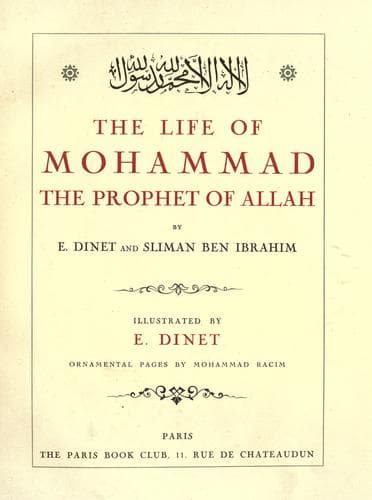
The Life of Mohammad, the Prophet of AllahDinet, Etienne
Religion
The Life of Mohammad, the Prophet of Allah
Dinet, Etienne
Muhammad, Prophet, -632
Does this mean that the empire of Islam, following the example of
Japan, will regain its rank among great political Powers? Considering
that the future of nations depends on the will of Allah, it is always
presumptuous to predict it. Besides, political might is the most
ephemeral of all; a few months are enough to overthrow the most
formidable empires. Such power proves nothing as regards the vitality
of a religion, and is not absolutely necessary for the subject we
treat.
There are, indeed, conquests differing from those of armies. The
imperialism of the Israelites, which disappeared centuries ago, has
never given the slightest sign of a return movement and yet few
peoples possess at present the power of the Jews. Persecution was for
them the great educator, and nowadays, in all the nations of Europe
and America, the Jews, thanks to their activity and intelligence,
occupy the front rank. Why does not the same effect, due to the same
cause--persecution--take place among the Moslems, who, for the most
part, are first, cousins to the Israelites and who possess the
advantage of numbers?
Objections are against the possibility of such a revival: Fatalism,
Fanaticism, Polygamy. Let us examine them.
Can Mussulman fatalism fit in with a real effort on the road to
progress?
If some criticisms are justified by the way in which fatalism is
understood by certain followers of the Murabitun, it has never
possessed the importance ascribed to it. Islam is not more fatalist
than determinism, and it is still less than Christianism which adheres
strictly to the letter of the following precepts of the Gospel:
'Therefore I say unto you, Take no thought for your life, what ye
shall eat, or what ye shall drink; nor yet for your body, what ye
shall put on.' (ST. MATTHEW, VI, 25.)
Why then accuse fatalism of having paralysed all effects among the
Moslems, when the Prophet was one of the most active, persevering and
energetic men that the world has ever known; and when Islam is the
only religion which, no sooner founded, was followed immediately by
such a marvellous épopée and such splendid civilisation? The word
"Islam" signifies "resignation to the decrees of Allah," that is to
say: to that which looks as if it could be mastered by energy and
courage. "_Say: O my people! Act as ye best can._" (THE QUR'AN, IV,
135.) Far from being the cause of weakness, such resignation becomes
the source of incomparable moral strength for the Believer, fortifying
him during the ordeals of adversity.
In their intercourse with civilised beings belonging to other
religions, will not Moslems be stopped by the implacable and
irreducible fanaticism of which they are accused? The main object is
to see if this fanaticism is not one of the countless legends
inimically invented during the Middle Ages. In order to permit the
reader to form an opinion, here are some extracts chosen among
thousands of the same kind.
Public-domain text, read in full here on John Shaqi.
Reviews
Reviews
No reviews yet
Be the first to share your thoughts on this work.
Elsewhere in the archive
Join the Discussion
Join the discussion
Sign in to leave a comment or review.
Sign InorCreate an account