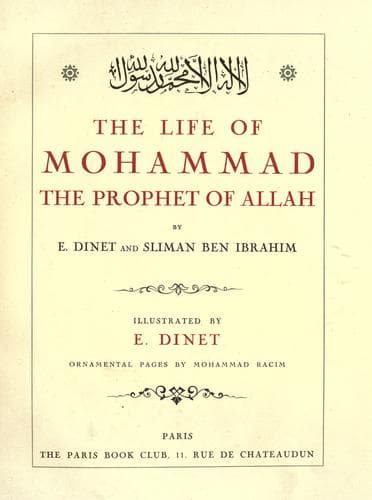
The Life of Mohammad, the Prophet of AllahDinet, Etienne
Religion
The Life of Mohammad, the Prophet of Allah
Dinet, Etienne
Muhammad, Prophet, -632
Umar was not a man to remain patient and conceal his convictions. In
the street, he stopped the first passer-by he met, one Jamil ibn
Mamar, of the Jumah tribe, and said to him: 'Dost know, O Jamil, that
I have become a Mussulman?' The words were hardly out of his mouth,
before Jamil, an incorrigible gossip, tucked his mantle tightly round
him and ran to the Temple. 'O Assembly of the Quraish men!' shouted he
to the idolaters who were there in groups. 'An astounding piece of
news! The son of Al Khattab hath lost his reason!'--'Thou liest!'
interrupted Umar who had followed him. 'On the contrary, I have set
out on the Road to Salvation. I bear witness that there is no other
God but Allah and that Mohammad is His Prophet!'
On hearing these words, amounting to insulting aggression, the Quraish
bounded forward, as one man, to throw themselves on Umar, who
steadfastly awaited their attack and a fearful struggle took place.
The sun, darting its flaming rays on the fighters, forced them to
desist for a short space of time. During the truce, Umar sat down on
the ground, surrounded by his enemies whose threatening hands were
stretched over his head. 'Do with me as ye will,' he told them in
tones of the most scornful indifference, 'but, by Allah! if I were
only at the head of three hundred Mussulmans, we should not be long
before we wrested this Temple from you, and never would ye be able to
retake it!'
[Illustration: _The Friday Visit of Moslems to the Cemetery._]
At this juncture, a respected old man, attired in a striped mantle and
a sumptuously embroidered tunic, drew nigh, brought there by the
tumult of which he asked the cause. 'Umar is demented,' was the
answer.--'How so?' said the old man to the idolaters. 'If this man
hath voluntarily chosen some religion different to yours, hath he not
a right to do so? What want ye of him? Moreover, think ye that his
relatives will not feel inclined to interfere on his behalf?' Struck
more by the fear of reprisals than by the wisdom of his words, Umar's
assailants clustering round him, dropped back and dispersed. It seemed
as if a heavy cloak had been lifted from his shoulders.
No one, except Mohammad, dared to pray in public. Umar, caring naught
for the fury he might cause, made up his mind to follow the Prophet's
example, and every day, the sturdy warrior turned like Mohammad in the
direction of the Bait-ul-Muquaddas (The Holy Temple of Jerusalem).
Doing exactly the same as the Prophet, Umar took his stand between the
angle of the Ka'bah where the Black Stone is enframed and the angle
looking towards the Yaman; and there publicly said his prayers.
Encouraged by this audacity, numerous were the Moslems who came to
pray in public by his side, despite the angry glances of the
Unbelievers, only restrained by the reputation of Umar who had earned
the surname of "Al Faruq," (The Cleaver), because he had once cleft in
twain an Arab who refused to bow down to a decision given out by the
Prophet.
Public-domain text, read in full here on John Shaqi.
Reviews
Reviews
No reviews yet
Be the first to share your thoughts on this work.
Elsewhere in the archive
Join the Discussion
Join the discussion
Sign in to leave a comment or review.
Sign InorCreate an account