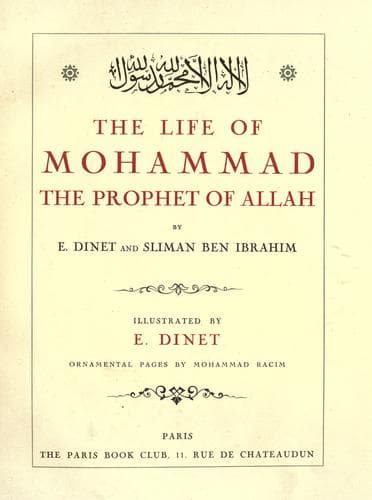
The Life of Mohammad, the Prophet of AllahDinet, Etienne
Religion
The Life of Mohammad, the Prophet of Allah
Dinet, Etienne
Muhammad, Prophet, -632
[Sidenote: THE EXILE OF THE BANU HA SHAM (_A.D. 626_)]
Despite the superiority of numbers, the idol-worshippers of the
Quraish were obliged to acknowledge the critical state of their party.
Unless they could put an end to the irresistible movement that daily
brought new conversions, their domination over the Arabs would soon
become a thing of the past.
They called a meeting, and, after consulting, resolved to break off
all relations with the Banu Hasham and the Banu Muttalib who were to
be banished from Makkah until they consented to hand over Mohammad,
their relative. In order to prevent themselves being tempted to break
their word, the Quraish leaders wrote out the conditions of this
compact on a sheet of parchment which they hung up inside the Ka'bah.
Their plan was most cunning. Among the Banu Hasham and the Banu
Muttalib were a large number of idolaters who the Quraish thought
would refuse to identify themselves with Mohammad and suffer for his
cause. Therefore, strife would be stirred up in the bosom of the
Prophet's family. But, contrary to the idol-worshippers' conjectures,
the example of Abu Talib, Mohammad's uncle, carried away all the
members of his family--with the exception of irreducible Abu
Lahab--actuated by feelings of unanimous solidarity.
This fact enables us to divine one of the reasons that prevented Abu
Talib from adopting the Islamic religion, although he worked hard and
successfully, helping it to triumph. He did not forget Abu Lahab's
ironical remark: 'Thou hast naught else to do than to obey thy son
Ali, now that Mohammad hath chosen him to be his lieutenant.' Abu
Talib's pride caused him to dread mockery. 'I would willingly become a
convert to Islam,' said he, one day, 'were it not that I fear to
become the laughing-stock of the men of Makkah when they would see me
saying my prayers.' Nevertheless, these motives would not have held
him back, if he had not considered that the protection he granted to
his nephew, threatened on all sides, would lose all its power
following the day when the uncle also should have abjured the religion
of his forefathers.
Directly after the proclamation of the decree of expulsion, the
members of the Prophet's family, Mussulmans or idolaters, left their
houses, scattered here and there in different districts of the town,
and assembled in a neighbouring ravine where Abu Talib possessed a
stronghold.
During a period of two years, the exiles endured the greatest
privations. Their provisions were quickly exhausted and it was
impossible to renew them. They were forbidden to show themselves in
the markets, and if one among them, having succeeded in getting to
follow a caravan, tried to procure a few articles of food, the
dealers, watched by Abu Jahal or fearing to be denounced, asked such
high prices that the luckless wight was obliged to give up all ideas
of purchase, and return empty-handed to his starving family.
Public-domain text, read in full here on John Shaqi.
Reviews
Reviews
No reviews yet
Be the first to share your thoughts on this work.
Elsewhere in the archive
Join the Discussion
Join the discussion
Sign in to leave a comment or review.
Sign InorCreate an account