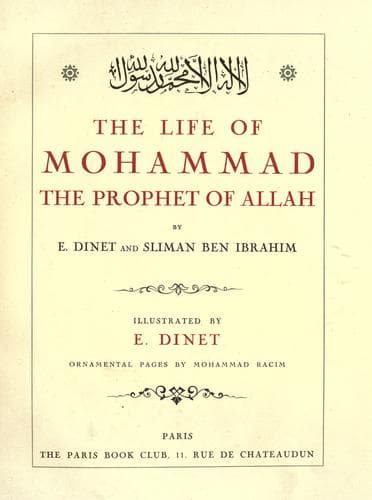
The Life of Mohammad, the Prophet of AllahDinet, Etienne
Religion
The Life of Mohammad, the Prophet of Allah
Dinet, Etienne
Muhammad, Prophet, -632
We need not copy the descriptions of this Ascension, or "Miraj," in
every detail. Many writers, particularly the Persians, have given a
free rein to their imagination in this connection, whilst others, more
serious, such as Ibn-i-Hisham, Ibn-i-Sad and Abul Fida, are content to
set forth an extremely simple narrative. We shall only mention
Mohammad's meeting with the Prophets known before him: Abraham, Moses
and Jesus; then his visit to the Paradise of Believers, where the
gardens honoured him by giving out sweet odours and his halt in Hell,
destined to receive Unbelievers, where the flames congealed when he
went along.
After having passed through the seven zones of the Heavens, it was not
long before he heard the scratching of pens writing in the "Book of
Fate," and the thanksgivings of the angels glorifying the Almighty.
Finally, he reached the "Sidratu'l-Muntaha," the "Lote-tree of the
Extremity." At this spot, Jibra'il left him, saying: "Here is the
boundary of Knowledge, where I am forced to halt. As for thee, O
Prince of Messengers! O friend of the Master of the Worlds! continue
thy glorious Ascension and progress in the Light of thy Lights." And
the Chosen One continued to pass through the veils covering that which
is hidden, until he reached the veil of Unity and looked upon that
which eyes cannot see, nor minds imagine. The eyes of his body would
not have been able to support the brilliancy of this sight which must
have brought on blindness. Therefore, Allah opened the eyes of
Mohammad's heart, thus permitting him to contemplate the Infinite
Splendour.
Allah bade him draw near to His throne, "_at the distance of two bows,
or even closer_" (THE QUR'AN, LIII, 9), and after having confirmed the
choice He had made in charging Mohammad to be the carrier of Good
Tidings to His servants, He fixed the number of prayers--fifty in
all--that each Believer should offer up daily to the Creator, in
gratitude for His bounty.
When the Chosen One went down, Moses met him again and questioned him.
'O Prophet of Allah! what hath our Master ordered thee with regard to
the number of prayers which His disciples should offer up?'--'Fifty
prayers during the day and the night.'--'O thou, the best of created
beings!' Moses rejoined, 'go back to our Master, and beg Him to
lighten this burden, too heavy for the weakness and laziness of
mankind.' So Mohammad went back several times into the presence of the
Master of the Worlds, until he prevailed upon Him to reduce the number
of prayers to five only.
This parable, which serves to decide definitively the number of daily
prayers, also demonstrates admirably that an excess of devotion, in
the Islamic creed, is considered to be an error. "_Allah desireth to
make your burden light to you: for man hath been created weak._" (THE
QUR'AN, IV, 32.) Why should the Almighty be in need of the prayers of
mankind? "_We ask not of Thee to make provision for thyself--We will
provide for Thee._" (THE QUR'AN, XX, 132.)
Public-domain text, read in full here on John Shaqi.
Reviews
Reviews
No reviews yet
Be the first to share your thoughts on this work.
Elsewhere in the archive
Join the Discussion
Join the discussion
Sign in to leave a comment or review.
Sign InorCreate an account