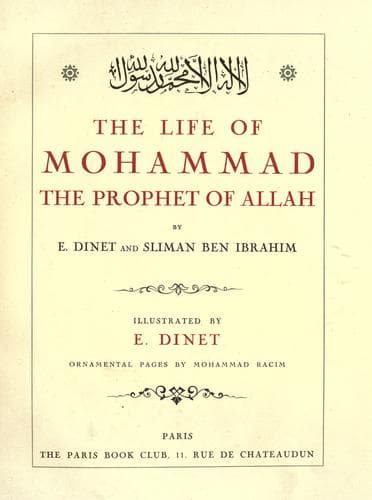
The Life of Mohammad, the Prophet of AllahDinet, Etienne
Religion
The Life of Mohammad, the Prophet of Allah
Dinet, Etienne
Muhammad, Prophet, -632
The Banu Amir ibn Auf to whom the hamlet of Quba belonged, now
arrived, transported with joy, to invite to sojourn in their midst the
illustrious guest sent to them by Allah. The Prophet lodged with
Kulsum ibn Hidmi; Abu Bakr with Khubib ibn Saf, while the other
Muhajirun took up their quarters with Sad ibn Khazimah, one of the
Najibs.
[Sidenote: THE ERA OF THE HEGIRA]
This happy ending of Mohammad's journey took place on a Monday, at
noon, the twelfth day of the month Rabi'u'l-Awwal. The year of this
emigration, renowned under the name of "Hijrah" (called "Hegira" by
the Europeans), has been adopted by Mussulmans for the beginning of
their era. It corresponds to A.D. 622.
At first, such a choice creates surprise, and yet no other event in
the Prophet's existence exercised more decisive influence over the
world-wide success of his cause. Had he remained in Makkah, granting
even his final triumph, Islam would have remained there with him. The
Arabs of all Arabia, fearing the power with which Islam endowed the
Quraish alone, would have formed a coalition to prevent it spreading
out of the Sacred City. Whereas, after having begun, despite all
malice, to plant the roots of his religion firmly in his native town,
it was easy for the Prophet to return there when he had won over the
rest of the Arabs to his cause.
This proves how impenetrable are the designs of Providence, and how
frequently the misfortunes with which God afflicts us, burdening us
with suffering, determine the cause of our successes. If the Prophet
had not been persecuted and banished by his own people, he would never
have been able to fulfil his universal mission, and the world would
never have been enlightened by Islam.
The Prophet sojourned at Quba Tuesday, Wednesday and Thursday. All
rejoined him there. His faithful henchman, after having restituted all
the deposits confided to his care to their rightful owners, arrived at
Quba, his feet badly lacerated, having tramped night and day. Mohammad
embraced him warmly, bandaged his wounds with his blessed hands, and
made him rest by his side in Kulsum's dwelling.
Mohammad also busied himself with laying the first brick of a
Mosque--the first place of public prayer in Islam--and left to Ammar
ibn Yasar the care of finishing it. This Mosque was called "At Taqwa,"
_i.e._ the Mosque of "The Fear of God." Reference is made to it in
these verses: "_There is indeed a Mosque founded from its first day
upon the fear of God; More right is it that thou take thy stand
therein; therein are men who aspire to keep themselves pure and Allah
loveth those who purify themselves._" (THE QUR'AN, IX, 109.)
[Sidenote: ARRIVAL OF THE PROPHET AT YASRIB]
Public-domain text, read in full here on John Shaqi.
Reviews
Reviews
No reviews yet
Be the first to share your thoughts on this work.
Elsewhere in the archive
Join the Discussion
Join the discussion
Sign in to leave a comment or review.
Sign InorCreate an account