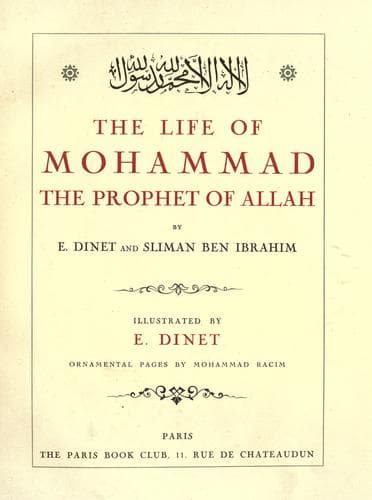
The Life of Mohammad, the Prophet of AllahDinet, Etienne
Religion
The Life of Mohammad, the Prophet of Allah
Dinet, Etienne
Muhammad, Prophet, -632
At early morn, the following day, he took to the road again, halting a
few miles away from the wells of Badr. The two scouts, guessing that
the caravan was heading towards this important spot for replenishing
water supplies, reached there by having urged on their camels
unmercifully. On arriving, they met two Bedouin women who were
quarrelling loudly, while they filled their goat-skins. With insulting
remarks, one claimed the repayment of a loan, and the woman in debt
replied: 'Have patience until to-morrow or the day after, for by then
the great caravan will have come back and thereby I shall have earned
enough to settle with thee.'--'She is right,' broke in An Najd, chief
of the Juhinna tribe, who happened to be at the well. 'They tell me
that the caravan will certainly be here to-morrow or the next day.'
Having got to know all they wanted, Bisbas and Adi watered their
animals and rode back in all haste to bring the news to the Prophet,
well pleased to see that things had turned out exactly as he foresaw.
A few minutes later, however, he was rejoined by one of his partisans
in his pay at Makkah. This friend brought bad news: the expedition of
the idol-worshippers was coming by forced marches to the succour of
Abu Sufyan. These tidings caused Mohammad the greatest anxiety: the
ardour of the Mussulmans, who had set out to attack a caravan defended
by a weak escort, might perhaps be damped upon finding themselves
faced by superior forces? He did not intend to hide the gravity of the
situation, but calling the head-men together, he laid the information
before them, and asked where they thought it would be best to make
their effort.
They were submerged by a great wave of vacillation. It must be
confessed that the irresistible bait of booty added great charm to a
wish to inflict punishment on the idolaters. Under the necessity of
coming to a decision, some of them objected: 'Dost thou lead us to be
slaughtered?' They were severely blamed for speaking thus. "_And
remember when Allah promised you that one of the two troops should
fall to you, and ye desired that they who had no arms should fall to
you._" (THE QUR'AN, VIII, 7.)
Then uprose Mikdad, protesting stoutly: 'O Prophet! go without
hesitation whither thou art ordered. By Allah! we'll not tell thee as
the Banu Israil told Moses: "Go fight by the side of the Lord and
we'll await thy return here!" On the contrary, we say to thee: "Go
fight by the side of thy Lord and thou wilt find us with thee, always
and everywhere."'
The Prophet called down divine blessings on the head of his courageous
disciple; and then added: 'Reflect, O my partisans!' He then turned
towards the Ansars who might not have considered themselves bound by
the oath of the Aqbah to do anything else than to protect him so long
as he dwelt in their town.
Public-domain text, read in full here on John Shaqi.
Reviews
Reviews
No reviews yet
Be the first to share your thoughts on this work.
Elsewhere in the archive
Join the Discussion
Join the discussion
Sign in to leave a comment or review.
Sign InorCreate an account