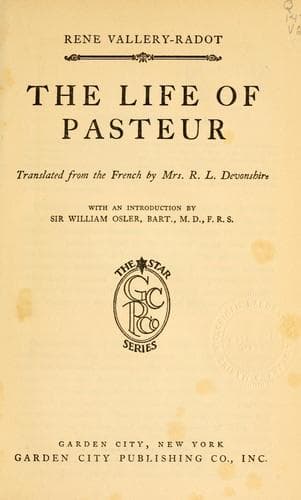
Pasteur, Louis, 1822-1895; Scientists -- France -- Biography
And yet Joly had written to the Académie, “If one only of our flasks
remains pure, we will loyally own our defeat.” A scientist who later
became Permanent Secretary of the Académie des Sciences, Jamin, wrote
about this conflict: “The heterogenists, however they may have coloured
their retreat, have condemned themselves. If they had been sure of the
fact--which they had solemnly engaged to prove or to own themselves
vanquished,--they would have insisted on showing it, it would have been
the triumph of their doctrine.”
The heterogenists appealed to the public. A few days after their defeat,
Joly gave a lecture at the Faculty of Medicine. He called the trial, as
decided on by the Commission, a “circus competition”; he was applauded
by those who saw other than scientific questions in the matter. The
problem was now coming down from mountains and laboratories into the
arena of society discussions. If all comes from a germ, people said,
whence came the first germ? We must bow before that mystery, said
Pasteur; it is the question of the origin of all things, and absolutely
outside the domain of scientific research. But an invincible curiosity
exists amongst most men which cannot admit that science should have the
wisdom to content itself with the vast space between the beginning of
the world and the unknown future. Many people transform a question of
fact into a question of faith. Though Pasteur had brought into his
researches a solely scientific preoccupation, many people approved or
blamed him as the defender of a religious cause.
Vainly had he said, “There is here no question of religion, philosophy,
atheism, materialism, or spiritualism. I might even add that they do not
matter to me as a scientist. It is a question of fact; when I took it up
I was as ready to be convinced by experiments that spontaneous
generation exists as I am now persuaded that those who believe it are
blindfolded.”
It might have been thought that Pasteur’s arguments were in support of a
philosophical theory! It seemed impossible to those whose ideas came
from an ardent faith, from the influence of their surroundings, from
personal pride or from interested calculations to understand that a man
should seek truth for its own sake and with no other object than to
proclaim it. Hostilities were opened, journalists kept up the fire. A
priest, the Abbé Moigno spoke of converting unbelievers through the
proved non-existence of spontaneous generation. The celebrated novelist,
Edmond About, took up Pouchet’s cause with sparkling irony. “M. Pasteur
preached at the Sorbonne amidst a concert of applause which must have
gladdened the angels.”
Public-domain text, read in full here on John Shaqi.
Reviews
Reviews
No reviews yet
Be the first to share your thoughts on this work.
Elsewhere in the archive
Join the Discussion
Join the discussion
Sign in to leave a comment or review.
Sign InorCreate an account