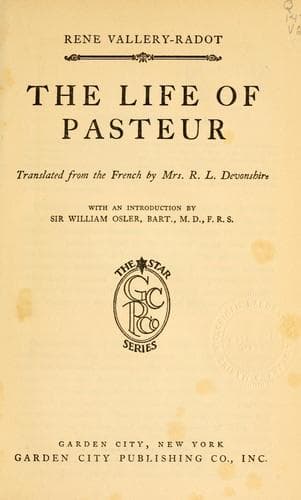
Pasteur, Louis, 1822-1895; Scientists -- France -- Biography
An epidemic was ruining in terrible proportions the industry of the
cultivation of silkworms. J. B. Dumas had been desired, as Senator, to
draw up a report on the wishes of over 3,500 proprietors in
sericicultural departments, all begging the public authorities to study
the question of the causes of the protracted epidemic. Dumas was all the
more preoccupied as to the fate of sericiculture that he himself came
from one of the stricken departments. He was born on July 14, 1800, in
one of the back streets of the town of Alais, to which he enjoyed
returning as a celebrated scientist and a dignitary of the Empire. He
gave much attention to all the problems which interested the national
prosperity and considered that the best judges in these matters were the
men of science. He well knew the conscientious tenacity--besides other
characteristics--which his pupil and friend brought into any
undertaking, and anxiously urged him to undertake this study. “Your
proposition,” wrote Pasteur in a few hurried lines, “throws me into a
great perplexity; it is indeed most flattering and the object is a high
one, but it troubles and embarrasses me! Remember, if you please, that I
have never even touched a silkworm. If I had some of your knowledge on
the subject I should not hesitate; it may even come within the range of
my present studies. However, the recollection of your many kindnesses to
me would leave me bitter regrets if I were to decline your pressing
invitation. Do as you like with me.” On May 17, 1865, Dumas wrote: “I
attach the greatest value to seeing your attention fixed on the question
which interests my poor country; the distress is beyond anything you can
imagine.”
Before his departure for Alais, Pasteur had read an essay on the history
of the silkworm, published by one of his colleagues, Quatrefages, born
like Dumas in the Gard. Quatrefages attributed to an Empress of China
the first knowledge of the art of utilizing silk, more than 4,000 years
ago. The Chinese, in possession of the precious insect, had jealously
preserved the monopoly of its culture, even to the point of making it a
capital offence to take beyond the frontiers of the Empire the eggs of
the silkworm. A young princess, 2,000 years later, had the courage to
infringe this law for love of her betrothed, whom she was going to join
in the centre of Asia, and also through the almost equally strong desire
to continue her fairy-like occupation after her marriage.
Public-domain text, read in full here on John Shaqi.
Reviews
Reviews
No reviews yet
Be the first to share your thoughts on this work.
Elsewhere in the archive
Join the Discussion
Join the discussion
Sign in to leave a comment or review.
Sign InorCreate an account