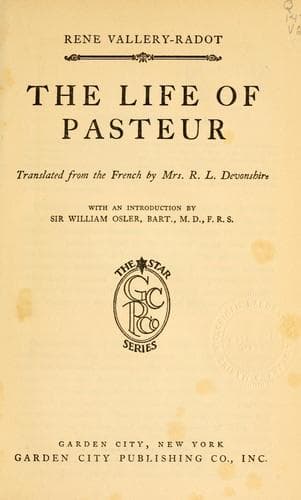
Pasteur, Louis, 1822-1895; Scientists -- France -- Biography
“I am arriving at this result that there is no silkworm disease. There
is but an exaggeration of a state of things which has always existed,
and it is not difficult, in my view, to return to the former situation,
even to improve on it. The evil was sought for in the worm and even in
the seed; that was something, but my observations prove that it develops
chiefly in the chrysalis, especially in the mature chrysalis, at the
moment of the moth’s formation, on the eve of the function of
reproduction. The microscope then detects its presence with certitude,
even when the seed and the worm seem very healthy. The practical result
is this: you have a nursery full; it has been successful or it has not;
you wish to know whether to smother the cocoons or whether to keep them
for reproduction. Nothing is simpler. You hasten the development of
about 100 moths through an elevation of temperature, and you examine
these moths through the microscope, which will tell you what to do.
“The sickly character is then so easy to detect that a woman or a child
can do it. If the cultivator should be a peasant, without the material
conditions required for this study, he can do this: instead of throwing
away the moths after they have laid their eggs, he can bottle a good
many of them in brandy and send them to a testing office or to some
experienced person who will determine the value of the seed for the
following year.”
The Japanese Government sent some cases of seed supposed to be healthy
to Napoleon III, who distributed them in the silkworm growing
departments. Pasteur, in the meanwhile, was stating the results he had
arrived at, and they were being much criticized. In order to avoid the
pébrine, which was indeed the disease caused by the corpuscles so
clearly visible through the microscope, he averred that no seed should
be used that came from infected moths. In order to demonstrate the
infectious character of the pébrine he would give to some worms meals of
leaves previously contaminated by means of a brush dipped in water
containing corpuscles. The worms absorbed the food, and the disease
immediately appeared and could be found in the chrysalides and moths
from those worms.
“I hope I am in the right road--close to the goal, perhaps, but I have
not yet reached it,” wrote Pasteur to his faithful Chappuis; “and as
long as the final proof is not acquired complications and errors are to
be feared. Next year, the growth of the numerous eggs I have prepared
will obviate my scruples, and I shall be sure of the value of the
preventive means I have indicated. It is tiresome to have to wait a year
before testing observations already made; but I have every hope of
success.”
Public-domain text, read in full here on John Shaqi.
Reviews
Reviews
No reviews yet
Be the first to share your thoughts on this work.
Elsewhere in the archive
Join the Discussion
Join the discussion
Sign in to leave a comment or review.
Sign InorCreate an account