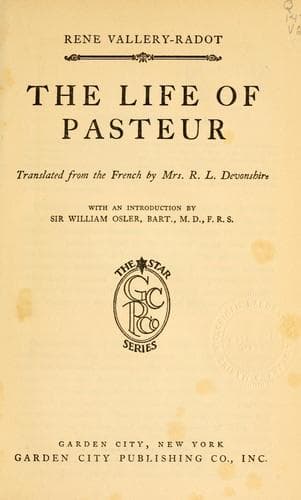
Pasteur, Louis, 1822-1895; Scientists -- France -- Biography
The Commission mentioned by Pasteur had been considering for the last
two years the expediency of applying the heating process to wines
destined for the fleet and to the colonies. A first trial was made at
Brest on the contents of a barrel of 500 litres, half of which was
heated. Then the two wines were sealed in different barrels and placed
in the ship _Jean Bart_, which remained away from the harbour for ten
months. When the vessel returned, the Commission noted the limpidity and
mellowness of the heated wine, adding in the official report that the
wine had acquired the attractive colour peculiar to mature wines. The
non-heated wine was equally limpid, but it had an astringent, almost
acid flavour. It was still fit to drink, said the report, but it were
better to consume it rapidly, as it would soon be entirely spoilt.
Identical results were observed in some bottles of heated and non-heated
wines at Rochefort and Orleans.
M. de Lapparent now organized a decisive experiment, to take place under
Pasteur’s superintendence. The frigate _la Sibylle_ started for a tour
round the world with a complete cargo of heated wine. Pasteur, who
returned to Arbois for a short rest before going back to Paris, wrote
from there to his early confidant, Chappuis (September 21, 1868): “I am
quite satisfied with my experiments at Toulon and with the success of
the Navy tests. We heated 650 hectolitres in two days; the rapidity of
this operation lends itself to quick and considerable commissariat
arrangements. Those 650 hectolitres will be taken to the West Coast of
Africa, together with 50 hectolitres of the same wine non-heated. If the
trial succeeds, that is to say if the 650 hectolitres arrive and can be
kept without alteration, and if the 50 hectolitres become spoilt (I feel
confident after the experiments I have made that such will be the
result), the question will be settled, and, in the future, all the wine
for the Navy will be ensured against disease by a preliminary heating.
The expense will not be more than five centimes per hectolitre. The
result of these experiments will have a great influence on the trade,
ever cautious and afraid of innovations. Yet we have seen, at Narbonne
in particular, some heating practised on a large scale by several
merchants who have spoken to me very favourably about it. The
exportation of our French wines will increase enormously, for at present
our ordinary table wines lend themselves to trade with England and other
countries beyond seas, but only by means of a strong addition of
alcohol, which raises their price and tampers with their hygienic
qualities.”
Public-domain text, read in full here on John Shaqi.
Reviews
Reviews
No reviews yet
Be the first to share your thoughts on this work.
Elsewhere in the archive
Join the Discussion
Join the discussion
Sign in to leave a comment or review.
Sign InorCreate an account