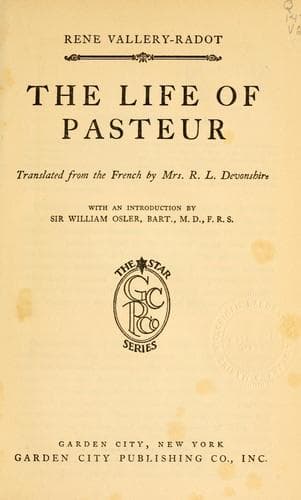
Pasteur, Louis, 1822-1895; Scientists -- France -- Biography
The rest of the colony returned to the Pont Gisquet, near Alais, that
mulberry-planted retreat, where, according to Pasteur, everything was
conducive to work. Pasteur now looked forward to his definitive victory,
and, full of confidence, organized his pupils’ missions. M. Duclaux, who
was coming to the Pont Gisquet to watch the normal broods, would
afterwards go into the Cévennes to verify the seedings made on the
selection system. M. Gernez was to note the results of some seedings
made by Pasteur himself the preceding year at M. Raibaud-Lange’s, at
Paillerols, near Digne (Basses Alpes). Raulin alone would remain at the
Pont Gisquet to study some points of detail concerning the flachery
disease. So many results ought surely to reduce contradictors to
silence!
“My dear friend and colleague,” wrote Dumas to Pasteur, “I need not tell
you with what anxiety we are watching the progress of your precious
health and of your silkworm campaign. I shall certainly be at Alais at
the end of the week, and I shall see, under your kind direction, all
that may furnish me with the means of guiding public opinion. You have
quacks to fight and envy to conquer, probably a hopeless task; the best
is to march right through them, Truth leading the way. It is not likely
that they will be converted or reduced to silence.”
Whilst these expeditions were being planned, a letter from M. Gressier,
the Minister of Agriculture, arrived very inopportunely. M. Gressier was
better versed in _sub rosâ_ ministerial combinations than in seeding
processes, and he asked Pasteur to examine three lots of seeds sent to
him by a Mademoiselle Amat, of Brives-la-Gaillarde, who was celebrated
in the department of the Corrèze for her good management of silkworms.
This _magnanarelle_, having had some successful results, was begging his
Excellency to accord to those humble seeds his particular consideration,
and to have them developed with every possible care.
At the same time she was sending samples of the same seeds to various
places in the Gard, the Bouches du Rhône, etc., etc.
M. Gressier (April 20) asked Pasteur to examine them and to give him a
detailed report. Pasteur answered four days afterwards in terms which
were certainly not softened by the usual administrative precautions--
“Monsieur le Ministre, ... these three sorts of seed are worthless. If
they are developed, even in very small nurseries, they will in every
instance succumb to corpuscle disease. If my seeding process had been
employed, it would not have required ten minutes to discover that
Mademoiselle Amat’s cocoons, though excellent for spinning purposes,
were absolutely unfit for reproduction. My seeding process gives the
means of recognizing those broods which are suitable for seed, whilst
opposing the production of the infected eggs which year by year flood
the silkworm cultivating departments.
Public-domain text, read in full here on John Shaqi.
Reviews
Reviews
No reviews yet
Be the first to share your thoughts on this work.
Elsewhere in the archive
Join the Discussion
Join the discussion
Sign in to leave a comment or review.
Sign InorCreate an account