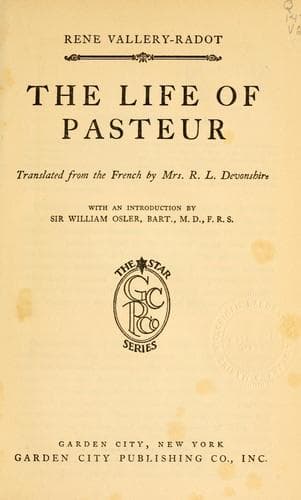
Pasteur, Louis, 1822-1895; Scientists -- France -- Biography
That glory, that legend had enveloped the childhood and youth of
Pasteur, who, as he advanced in life, still preserved the same
enthusiasm. His imagination pictured the Emperor, calm in the midst of
battles, or reviewing his troops surrounded by an escort of field
marshals, entering as a sovereign a capital not his own, then
overwhelmed by numbers at Waterloo, and finally condemned to exile and
inactivity, and dying in a long drawn agony. Glorious or lugubrious,
those visions came back to him with poignant insistency in those days of
September, 1870. What was Waterloo compared to Sedan! The departure for
St. Helena had the grandeur of the end of an epic; it seemed almost
enviable by the side of that last episode of the Second Empire, when
Napoleon III, vanquished, spared by the death which he wooed, left Sedan
by the Donchery road to enter the cottage where Bismarck was to inform
him of the rendezvous given by the King of Prussia.
The Emperor had now but a shadow of power, having made the Empress
Regent before he left Paris; it was therefore not the sword of France,
but his own, that he was about to surrender. But he thought he might
hope that the King of Prussia would show clemency to the French army and
people, having many times declared that he made war on the Emperor and
not on France.
“Can it be credited,” said Bismarck, speaking afterwards of that
interview, “that he actually believed in our generosity!” The chancellor
added, speaking of that somewhat protracted _tête-à-tête_, “I felt as I
used to in my youth, when my partner in a cotillon was a girl to whom I
did not quite know what to say, and whom nobody would fetch away for a
turn!”
Napoleon III and the King of Prussia met in the Château of Bellevue, in
the neighbourhood of Sedan, opposite a peninsula henceforth known by the
sad name of “Camp of Misery.” The Emperor looked for the last time upon
his 83,000 soldiers, disarmed, starving, waiting in the mud for the
Prussian escort which was to convey them as prisoners far beyond the
Rhine. Wilhelm did not even pronounce the word peace.
Jules Favre, taking possession on September 6 of the department of
Foreign Affairs, recalled to the diplomatic agents the fall of the
Empire and the words of the King of Prussia; then in an unaccustomed
outburst of eloquence exclaimed: “Does the King of Prussia wish to
continue an impious struggle which will be as fatal to him as to us?
Does he wish to give to the world in the nineteenth century the cruel
spectacle of two nations destroying each other and forgetful of human
feelings, of reason and of science, heaping up ruin and death? Let him
then assume the responsibility before the world and before posterity!”
And then followed the celebrated phrase with which he has been violently
and iniquitously reproached, and which expressed the unanimous sentiment
of France: “We will not concede one inch of our territory nor a stone of
our fortifications.”
Public-domain text, read in full here on John Shaqi.
Reviews
Reviews
No reviews yet
Be the first to share your thoughts on this work.
Elsewhere in the archive
Join the Discussion
Join the discussion
Sign in to leave a comment or review.
Sign InorCreate an account