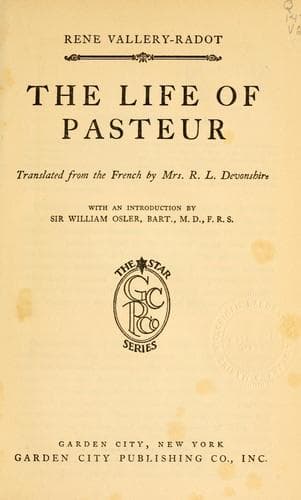
Pasteur, Louis, 1822-1895; Scientists -- France -- Biography
Jules Favre had deluded himself into thinking that victorious Prussia
would limit its demands to a war indemnity, probably a formidable one.
But Bismarck, besides the indemnity, intended to take a portion of
French soil, and claimed Strasburg first of all. “It is the key of the
house; I must have it.” And with Strasburg he wanted the whole
Department of the _Haut-Rhin_, that of the _Bas-Rhin_, Metz, and a part
of the Department of _Moselle_. Jules Favre, characteristically French,
exhausted his eloquence in putting sentiment into politics, spoke of
European rights, of the right of the people to dispose of themselves,
tried to bring out the fact that a brutal annexation was in direct
opposition to the progress of civilization. “I know very well,” said
Bismarck, “that they (meaning the Alsatians and Lorrainers) do not want
us; they will give us a deal of trouble, but we must annex them.” In the
event of a future war Prussia was to have the advantage. All this was
said with an authoritative courtesy, an insolent tranquillity, through
which contempt for men was visible, evidently the best means of
governing them in Bismarck’s eyes. As Jules Favre was pleading the cause
of heroic Strasburg, whose long resistance was the admiration of Paris,
“Strasburg will now fall into our hands,” said Bismarck coldly; “it is
but a question for engineers; therefore I request that the garrison
should surrender as prisoners of war.”
Jules Favre “leapt in his grief”--the words are his--but King Wilhelm
exacted this condition. Jules Favre, almost breaking down, turning away
to hide the tears that welled into his eyes, ended the interview with
these words: “It is an indefinite struggle between two nations who
should go hand in hand.”
Traces of this patriotic anguish are to be found in one of Pasteur’s
notebooks, as well as a circular addressed by Jules Favre to the
diplomatic representatives in answer to certain points disputed by
Bismarck. Pasteur admiringly took note of the following passage: “I know
not what destinies Fate has in store for us. But I do feel most deeply
that if I had to choose between the present situation of France and that
of Prussia, I should decide for the former. Better far our sufferings,
our perils, our sacrifices, than the cruel and inflexible ambition of
our foe.”
“We must preserve hope until the end,” wrote Pasteur after reading the
above, “say nothing to discourage each other, and wish ardently for a
prolonged struggle. Let us think of hopeful things; Bazaine may save
us.”... How many French hearts were sharing that hope at the very time
when Bazaine was preparing to betray Metz, his troops and his flag!
“Should we not cry: ‘Happy are the dead!’” wrote Pasteur a few days
after the news burst upon France of that army lost without being allowed
to fight, of that city of Metz, the strongest in France, surrendered
without a struggle!
Public-domain text, read in full here on John Shaqi.
Reviews
Reviews
No reviews yet
Be the first to share your thoughts on this work.
Elsewhere in the archive
Join the Discussion
Join the discussion
Sign in to leave a comment or review.
Sign InorCreate an account