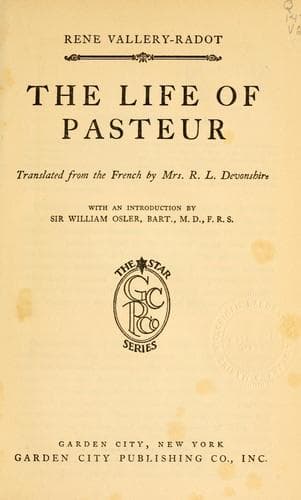
Pasteur, Louis, 1822-1895; Scientists -- France -- Biography
One of the correspondents of the Institute, the surgeon Sédillot, who
was in Alsace at the head of an ambulance corps, and who himself
performed as many as fifteen amputations in one day, addressed two
noteworthy letters to the President of the Academy. Those letters mark a
date in the history of surgery, and show how restricted was then in
France the share of some of Pasteur’s ideas at the very time when in
other countries they were adopted and followed. Lister, the celebrated
English surgeon, having, he said, meditated on Pasteur’s theory of
germs, and proclaimed himself his follower, convinced that complications
and infection of wounds were caused by their giving access to living
organisms and infectious germs, elements of trouble, often of death, had
already in 1867 inaugurated a method of treatment. He attempted the
destruction of germs floating in air by means of a vaporizer filled with
a carbolic solution, then isolated and preserved the wound from the
contact of the air. Sponges, drainage tubes, etc., were subjected to
minute precautions; in one word, he created antisepsis. Four months
before the war he had propounded the principles which should guide
surgeons, but it occurred to no one in France, in the first battles, to
apply the new method. “The horrible mortality amongst the wounded in
battle,” writes Sédillot, “calls for the attention of all the friends of
science and humanity. The surgeon’s art, hesitating and disconcerted,
pursues a doctrine whose rules seem to flee before research.... Places
where there are wounded are recognizable by the fetor of suppuration and
gangrene.”
Hundreds and thousands of wounded, their faces pale, but full of hope
and desire to live, succumbed between the eighth and tenth day to
gangrene and erysipelas. Those failures of the surgery of the past are
plain to us now that the doctrine of germs has explained everything;
but, at that time, such an avowal of impotence before the mysterious
_contagium sui generis_, which, the doctors averred, eluded all
research, and such awful statistics of mortality embittered the anguish
of defeat.
The Academy then attempted to take a share in the national co-operation
by making a special study of any subject which interested the public
health and defence. A sitting on methods of steering balloons was
succeeded by another on various means of preserving meat during the
siege. Then came an anxious inquiry into modes of alimentation of
infants. At the end of October there were but 20,000 litres of milk per
day to be procured in the whole of Paris, and the healthy were implored
to abstain from it. It was a question of life and death for young
children, and already many little coffins were daily to be seen on the
road to the cemetery.
Public-domain text, read in full here on John Shaqi.
Reviews
Reviews
No reviews yet
Be the first to share your thoughts on this work.
Elsewhere in the archive
Join the Discussion
Join the discussion
Sign in to leave a comment or review.
Sign InorCreate an account