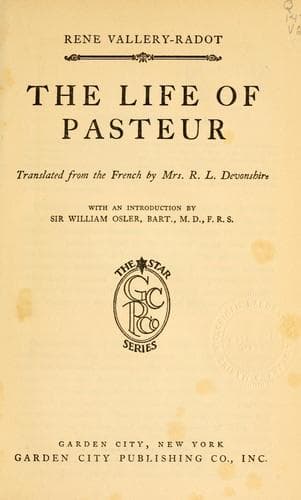
Pasteur, Louis, 1822-1895; Scientists -- France -- Biography
“Written at Arbois (Jura) on January 18, 1871, after reading the mark of
infamy inscribed on the forehead of your King by the illustrious
director of the Museum of Natural History M. Chevreul.”
“This letter will not have much weight with a people whose principles
differ so totally from those that inspire us,” said Pasteur, “but it
will at least echo the indignation of French scientists.”
He made a collection of stories, of episodes, and letters, which fell in
his way; amongst other things we find an open letter from General Chanzy
to the commandant of the Prussian troops at Vendôme, denouncing the
insults, outrages, and inexcusable violence of the Prussians towards the
inhabitants of St. Calais, who had shown great kindness to the enemy’s
sick and wounded.
“You respond by insolence, destruction and pillage to the generosity
with which we treat your prisoners and wounded. I indignantly protest,
in the name of humanity and of the rights of men, which you trample
under foot.”
Pasteur also gathered up tales of bravery, of heroism, and of
resignation--that form of heroism so often illustrated by women--during
the terrible siege of Paris. And, from all those things, arose the
psychology of war in its two aspects: in the invading army a spirit of
conquest carried to oppression, and even apart from the thrilling
moments of battle, giving to hatred and cruelty a cold-blooded sanction
of discipline; in the vanquished nation, an irrepressible revolt, an
intoxication of sacrifice. Those who have not seen war do not know what
love of the mother country means.
France was the more loved that she was more oppressed; she inspired her
true sons with an infinite tenderness. Sully-Prudhomme, the poet of
pensive youth, renouncing his love for Humanity in general, promised
himself that he would henceforth devote his life to the exclusive love
of France. A greater poet than he, Victor Hugo, wrote at that time the
first part of his _Année Terrible_, with its mingled devotion and
despair.
The death of Henri Regnault was one of the sad episodes of the war. This
brilliant young painter--he was only twenty-seven years of age--enlisted
as a _garde nationale_, though exempt by law from any military service
through being a laureate of the _prix de Rome_.[30] He did his duty
valiantly, and on January 19, at the last sortie attempted by the
Parisians, at Buzenval, the last Prussian shot struck him in the
forehead. The Académie des Sciences, at its sitting of January 23,
rendered homage to him whose coffin enclosed such dazzling prospects and
some of the glory of France. The very heart of Paris was touched, and a
great sadness was felt at the funeral procession of the great artist who
seemed an ideal type of all the youth and talent so heroically
sacrificed--and all in vain--for the surrender of Paris had just been
officially announced.
Public-domain text, read in full here on John Shaqi.
Reviews
Reviews
No reviews yet
Be the first to share your thoughts on this work.
Elsewhere in the archive
Join the Discussion
Join the discussion
Sign in to leave a comment or review.
Sign InorCreate an account