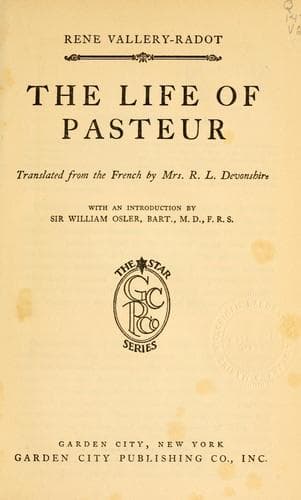
Pasteur, Louis, 1822-1895; Scientists -- France -- Biography
M. Duclaux was then professor of chemistry at the Faculty of Clermont
Ferrand, a short distance from Royat, and Pasteur intended to walk every
day to the laboratory of his former pupil. But M. Duclaux did not
countenance this plan; he meant to entertain his master and his master’s
family in his own house, 25, Rue Montlosier, where he could even have
one room arranged as a silkworm nursery. He succeeded in persuading
Pasteur, and they organized a delightful home life which recalled the
days at Pont Gisquet before the war.
Pasteur was seeking the means of making his seed-selecting process
applicable to small private nurseries as well as to large industrial
establishments. The only difficulty was the cost of the indispensable
microscope; but Pasteur thought that each village might possess its
microscope, and that the village schoolmaster might be entrusted with
the examination of the moths.
In a letter written in April, 1871, to M. Bellotti, of the Milan Civic
Museum, Pasteur, after describing in a few lines the simple process he
had taken five years to study, added--
“If I dared to quote myself, I would recall those words from my book--
“‘If I were a silkworm cultivator I never would raise seed from worms I
had not observed during the last days of their life, so as to satisfy
myself as to their vigour and agility just before spinning. The seed
chosen should be that which comes from worms who climbed the twigs with
agility, who showed no mortality from flachery between the fourth
moulting and climbing time, and whose freedom from corpuscles will have
been demonstrated by the microscope. If that is done, any one with the
slightest knowledge of silkworm culture will succeed in every case.’”
Italy and Austria vied with each other in adopting the seed selected by
the Pasteur system. But it was only when Pasteur was on the eve of
receiving from the Austrian Government the great prize offered in 1868
to “whoever should discover a preventive and curative remedy against
pébrine” that French sericicultors began to be convinced. The French
character offers this strange contrast, that France is often willing to
risk her fortune and her blood for causes which may be unworthy, whilst
at another moment, in everyday life, she shrinks at the least innovation
before accepting a benefit originated on her own soil. The French often
wait until other nations have adopted and approved a French discovery
before venturing to adopt it in their turn.
Pasteur did not stop to look back and delight in his success, but
hastened to turn his mind to another kind of study. His choice of a
subject was influenced by patriotic motives. Germany was incontestably
superior to France in the manufacture of beer, and he conceived the
thought of making France a successful rival in that respect; in order to
enable himself to do so, he undertook to study the scientific mechanism
of beer manufacture.
Public-domain text, read in full here on John Shaqi.
Reviews
Reviews
No reviews yet
Be the first to share your thoughts on this work.
Elsewhere in the archive
Join the Discussion
Join the discussion
Sign in to leave a comment or review.
Sign InorCreate an account