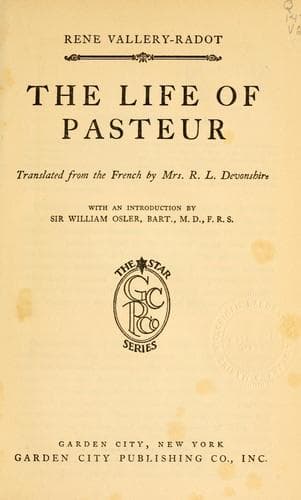
Pasteur, Louis, 1822-1895; Scientists -- France -- Biography
It would have been an act of graceful welcome to Pasteur, and a fitting
homage to the memory of the celebrated Trousseau, who had died five
years before, in 1867, if any member present had then quoted one of the
great practitioner’s last lectures at the Hôtel Dieu, wherein he
predicted a future for Pasteur’s works:
“The great theory of ferments is therefore now connected with an organic
function; every ferment is a germ, the life of which is manifested by a
special secretion. It may be that it is so for morbid viruses; they may
be ferments, which, deposited within the organism at a given moment and
under determined circumstances, manifest themselves by divers products.
So will the variolous ferment produce variolic fermentation, giving
birth to thousands of pustules, and likewise the virus of glanders, that
of sheep pox, etc....
“Other viruses appear to act locally, but, nevertheless, they ultimately
modify the whole organism, as do gangrene, malignant pustula, contagious
erysipelas, etc. May it not be supposed, under such circumstances, that
the ferment or organized matter of those viruses can be carried about by
the lancet, the atmosphere or the linen bandages?”
But it occurred to no one in the Academy to quote those forgotten words.
Pasteur, answering Bouillaud, recalled his own researches on lactic and
butyric fermentations and spoke of his studies on beer. He stated that
the alteration of beer was due to the presence of filiform organisms; if
beer becomes altered, it is because it contains germs of organized
ferments. “The correlation is certain, indisputable, between the disease
and the presence of organisms.” He spoke those last words with so much
emphasis that the stenographer who was taking down the extempore
speeches underlined them.
A few months later, on November 17, 1873, he read to the Academy a paper
containing further developments of his principles. “In order that beer
should become altered and become sour, putrid, slimy, ‘ropy,’ acid or
lactic, it is necessary that foreign organisms should develop within it,
and those organisms only appear and multiply when those germs are
already extant in the liquid mass.” It is possible to oppose the
introduction of those germs; Pasteur drew on the blackboard the diagram
of an apparatus which only communicated with the outer air by means of
tubes fulfilling the office of the sinuous necks of the glass vessels he
had used for his experiments on so-called spontaneous generation. He
entered into every detail, demonstrating that as long as pure yeast
alone had been sown, the security was absolute. “That which has been put
forward on the subject of a possible transformation of yeast into
bacteria, vibriones, _mycoderma aceti_ and vulgar mucors, or vice versa,
is mistaken.”
He wrote in a private letter on the subject: “These simple and clear
results have cost me many sleepless nights before presenting themselves
before me in the precise form I have now given them.”
Public-domain text, read in full here on John Shaqi.
Reviews
Reviews
No reviews yet
Be the first to share your thoughts on this work.
Elsewhere in the archive
Join the Discussion
Join the discussion
Sign in to leave a comment or review.
Sign InorCreate an account