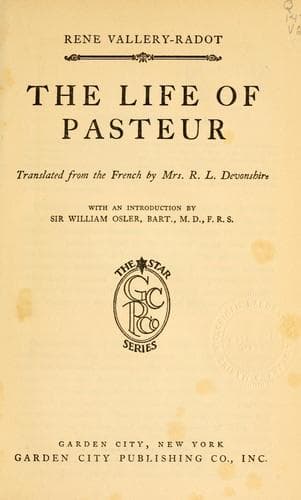
Pasteur, Louis, 1822-1895; Scientists -- France -- Biography
“Finally, I should like to cut open a wound on an animal under
chloroform in a very carefully selected part of the body--for the
experiment would be a very delicate one--and in absolutely pure air,
that is, air absolutely devoid of any kind of germs, afterwards
maintaining a pure atmosphere around the wound, and having recourse to
no dressing whatever. I am inclined to think that perfect healing would
ensue under such conditions, for there would be nothing to hinder the
work of repair and reorganization which must be accomplished on the
surface of a wound if it is to heal.”
He explained in that way the advantage accruing to hygiene, in hospitals
and elsewhere, from infinite precautions of cleanliness and the
destroying of infectious germs. Himself a great investigator of new
ideas, he intended to compel his colleagues at the Académie de Médecine
to include the pathogenic share of the infinitesimally small among
matters demanding the attention of medicine and surgery. The struggle
was a long, unceasing and painful one. In February, 1875, his presence
gave rise to a discussion on ferments, which lasted until the end of
March. In the course of this discussion he recalled the experiments he
had made fifteen years before, describing how--in a liquid composed of
mineral elements, apart from the contact of atmospheric air and
previously raised to ebullition--vibriones could be sown and
subsequently seen to flourish and multiply, offering the sight of those
two important phenomena: life without air, and fermentation.
“They are far behind us now,” he said; “they are now relegated to the
rank of chimeras, those theories of fermentation imagined by Berzelius,
Mitscherlich, and Liebig, and re-edited with an accompaniment of new
hypotheses by Messrs. Pouchet, Frémy, Trécul, and Béchamp. Who would now
dare to affirm that fermentations are contact phenomena, phenomena of
motion, communicated by an altering albuminoid matter, or phenomena
produced by semi-organized materia, transforming themselves into this or
into that? All those creations of fancy fall to pieces before this
simple and decisive experiment.”
Pasteur ended up his speech by an unexpected attack on the pompous
etiquette of the Academy’s usual proceedings, urging his colleagues to
remain within the bounds of a scientific discussion instead of making
flowery speeches. He was much applauded, and his exhortation taken in
good part. His colleagues also probably sympathized with his irritation
in hearing a member of the assembly, M. Poggiale, formerly apothecary in
chief to the Val de Grâce, give a somewhat sceptical dissertation on
such a subject as spontaneous generation, saying disdainfully--
Public-domain text, read in full here on John Shaqi.
Reviews
Reviews
No reviews yet
Be the first to share your thoughts on this work.
Elsewhere in the archive
Join the Discussion
Join the discussion
Sign in to leave a comment or review.
Sign InorCreate an account