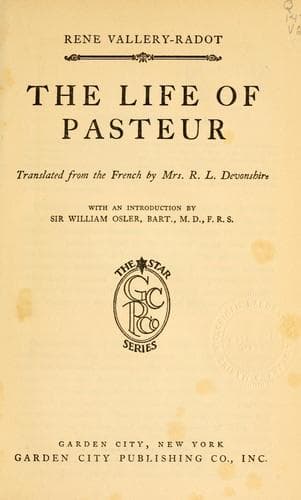
Pasteur, Louis, 1822-1895; Scientists -- France -- Biography
“What is then your idea of the progress of Science? Science advances one
step, then another, and then draws back and meditates before taking a
third. Does the impossibility of taking that last step suppress the
success acquired by the two others? Would you say to an infant who
hesitated before a third step, having ventured on two previous ones;
‘Thy former efforts are of no avail; never shalt thou walk’?
“You wish to upset what you call my theory, apparently in order to
defend another; allow me to tell you by what signs these theories are
recognized: the characteristic of erroneous theories is the
impossibility of ever foreseeing new facts; whenever such a fact is
discovered, those theories have to be grafted with further hypotheses in
order to account for them. True theories, on the contrary, are the
expression of actual facts and are characterized by being able to
predict new facts, a natural consequence of those already known. In a
word, the characteristic of a true theory is its fruitfulness.”
“Science,” said he again at the following sitting of the Academy,
“should not concern itself in any way with the philosophical
consequences of its discoveries. If through the development of my
experimental studies I come to demonstrate that matter can organize
itself of its own accord into a cell or into a living being, I would
come here to proclaim it with the legitimate pride of an inventor
conscious of having made a great discovery, and I would add, if provoked
to do so, ‘All the worse for those whose doctrines or systems do not fit
in with the truth of the natural facts.’
“It was with similar pride that I defied my opponents to contradict me
when I said, ‘In the present state of science the doctrine of
spontaneous generation is a chimera.’ And I add, with similar
independence, ‘All the worse for those whose philosophical or political
ideas are hindered by my studies.’
“This is not to be taken to mean that, in my beliefs and in the conduct
of my life, I only take account of acquired science: if I would, I could
not do so, for I should then have to strip myself of a part of myself.
There are two men in each one of us: the scientist, he who starts with a
clear field and desires to rise to the knowledge of Nature through
observation, experimentation and reasoning, and the man of sentiment,
the man of belief, the man who mourns his dead children, and who cannot,
alas, prove that he will see them again, but who believes that he will,
and lives in that hope, the man who will not die like a vibrio, but who
feels that the force that is within him cannot die. The two domains are
distinct, and woe to him who tries to let them trespass on each other in
the so imperfect state of human knowledge.”
Public-domain text, read in full here on John Shaqi.
Reviews
Reviews
No reviews yet
Be the first to share your thoughts on this work.
Elsewhere in the archive
Join the Discussion
Join the discussion
Sign in to leave a comment or review.
Sign InorCreate an account