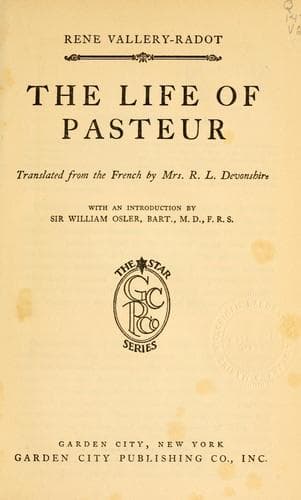
Pasteur, Louis, 1822-1895; Scientists -- France -- Biography
Everything was subordinate to the laboratory; Pasteur never accepted an
invitation to those large social gatherings which are a tax laid by
those who have nothing to do on the time of those who are busy,
especially if they be celebrated. Pasteur’s name, known throughout the
world, was never mentioned in fashionable journals; he did not even go
to theatres. In the evening, after dinner, he usually perambulated the
hall and corridor of his rooms at the Ecole Normale, cogitating over
various details of his work. At ten o’clock, he went to bed, and at
eight the next morning, whether he had had a good night or a bad one, he
resumed his work in the laboratory.
That regular life, preserving its even tenor through so many polemics
and discussions, was momentarily perturbed by politics in January,
1876. Pasteur, who, in his extraordinary, almost disconcerting modesty,
believed that a medical diploma would have facilitated his scientific
revolution, imagined--after the pressing overtures made to him by some
of his proud compatriots--that he would be able to serve more usefully
the cause of higher education if he were to obtain a seat at the Senate.
He addressed from Paris a letter to the senatorial electors of the
department of Jura. “I am not a political man,” he said, “I am bound to
no party; not having studied politics I am ignorant of many things, but
I do know this, that I love my country and have served her with all my
strength.” Like many good citizens, he thought that a renewal of the
national grandeur and prosperity might be sought in a serious
experimental trial of the Republic. If honoured with the suffrages of
his countrymen, he would “represent in the Senate, Science in all its
purity, dignity and independence.” Two Jura newspapers, of different
opinions, agreed in regretting that Pasteur should leave “the peaceful
altitudes of science,” and come down into the Jura to solicit the
electors’ suffrages.
In his answers to such articles, letters dictated to his son--who acted
as his secretary during that electoral campaign and accompanied him to
Lons-le-Saulnier, where they spent a week, published addresses, posters,
etc.--Pasteur invoked the following motto, “_Science et Patrie_.” Why
had France been victorious in 1792? “Because Science had given to our
fathers the material means of fighting.” And he recalled the names of
Monge, of Carnot, of Fourcroy, of Guyton de Morveau, of Berthollet, that
concourse of men of science, thanks to whom it had been possible--during
that grandiose epoch--to hasten the working of steel and the preparation
of leather for soldiers’ boots, and to find means of extracting
saltpetre for gunpowder from plaster rubbish, of making use of
reconnoitring balloons and of perfecting telegraphy.
Public-domain text, read in full here on John Shaqi.
Reviews
Reviews
No reviews yet
Be the first to share your thoughts on this work.
Elsewhere in the archive
Join the Discussion
Join the discussion
Sign in to leave a comment or review.
Sign InorCreate an account